

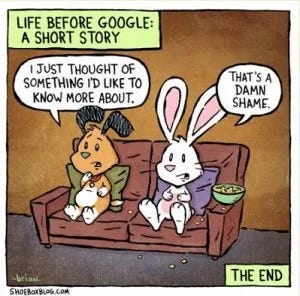
People talk about the risks of using modern AI - if you use AI, how are you going to learn to think? While we need to take this issue seriously, we shouldn’t forget the huge upsides of AI. I used to wonder about many questions that were too difficult to search online for answers. Even when I would do a search, it would take a while to read through the results to find the relevant answer. It’s now possible to immediately get answers to questions on any topic. There is now a tool to help those who remain curious about the world. Modern AI continues to spread knowledge, just like writing, printing, the internet and search did before.
AI also unlocks information that was inaccessible before. Published research is not written in a user-friendly manner and reading the original papers is often an inefficient way to understand the topic. For example, see this discussion between Dwarkesh Patel and Andrej Karpathy:
Dwarkesh: …If somebody writes a paper or a blog post or an announcement, it is in 100% of cases that just the narration or the transcription of how they would explain it to you over lunch is way more, not only understandable, but actually also more accurate and scientific, in the sense that people have a bias to explain things in the most abstract, jargon-filled way possible and to clear their throat for four paragraphs before they explain the central idea. But there’s something about communicating one-on-one with a person which compels you to just say the thing.
Andrej: …You read someone’s paper, and you work to understand what it’s doing. Then you catch them, you’re having beers at the conference later, and you ask them, “So this paper, what were you doing? What is the paper about?”
They will just tell you these three sentences that perfectly captured the essence of that paper and totally give you the idea. And you didn’t have to read the paper. It’s only when you’re sitting at the table with a beer or something, and they’re like, “Oh yeah, the paper is just, you take this idea, you take that idea and try this experiment and you try out this thing.” They have a way of just putting it conversationally just perfectly. Why isn’t that the abstract?
Most of us can’t grab the author of the paper for a beer, but we can upload the paper to AI and start a conversation about what’s going on. The AI might not represent everything perfectly but (as discussed in my recent podcast with Mike Todasco), this is better than the practical alternative: not reading the paper! In many cases the AI will also be more accurate than a popular article on the paper, and you can drill into the specific topics you’re interested in.
Papers might be unclear since they follow a specific academic style, but some information is hidden for other reasons. Clear medical info is difficult to find online for liability reasons, see this post from Scott Alexander:
Drug 1 is aspirin. Drug 2 is warfarin, which causes 40,000 ER visits a year and is widely considered one of the most dangerous drugs in common use. I challenge anyone to figure out, using WebMD's side effects list alone, that warfarin is more dangerous than aspirin. I think this is because if WebMD said "aspirin is pretty safe and most people don't need to worry about it", people might use aspirin irresponsibly, die, and then their ghosts might sue WebMD. Or if WebMD said "warfarin can be dangerous, be careful with this one", people might refuse to take warfarin because "the Internet said it was dangerous", die of the stuff warfarin is supposed to treat, and then their ghosts might sue WebMD. WebMD solves this by never giving the tiniest shred of useful information to anybody.
Initially the AI providers avoided answering health queries since they too were worried what would happen if they gave the wrong answer. This concern hasn’t completely disappeared, but the more advanced AI models are now willing to answer health queries. You can now get answers that were too difficult to find before, including getting detailed info on specific medicines, as well as comparing their tradeoffs and discussing how well each medicine meets your specific needs. As I mentioned recently, it’s worthwhile to use AI’s Deep Research option for important medical queries, and then you can chat with the AI about follow-up questions. While the AI chats have improved in accuracy (especially since rolling out thinking and search), in chat mode they may still miss certain info. It’s a good idea to follow up with the AI on specific details, to double check with another AI model, or to review some of the specific sources the AI links to.