

I used to AI to create a free quick online 4X strategy game, you can play it here:
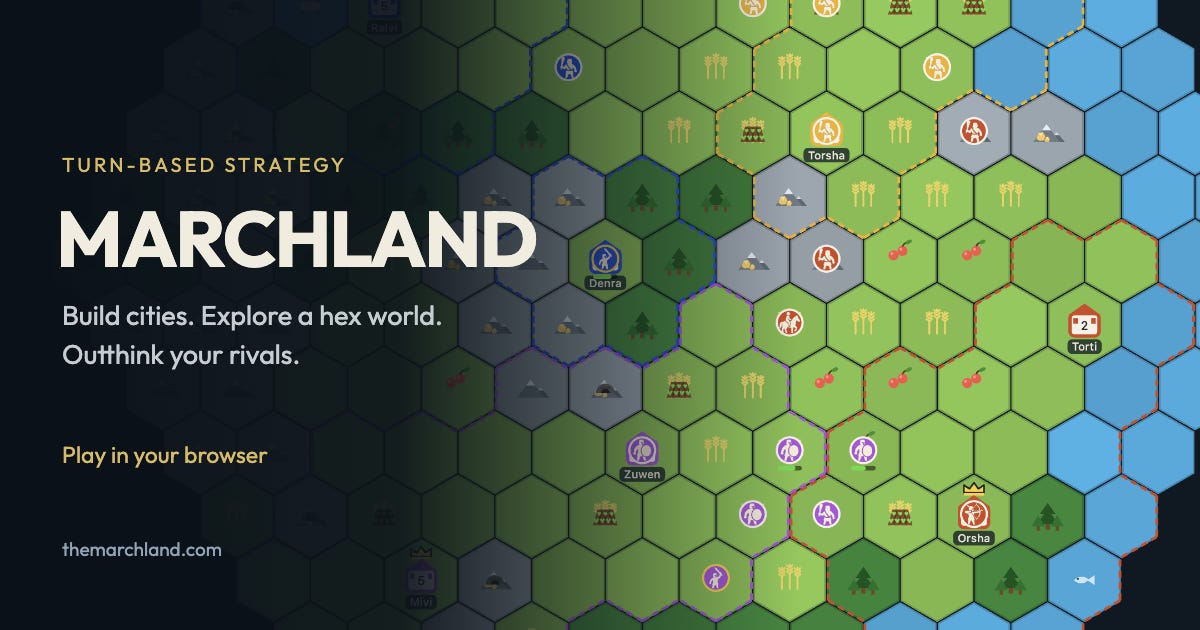
The game is named “The Marchland” since a marchland is a border region between two countries or realms.
The game is similar to another game, Polytopia, but it uses a hexagonal board, has slightly simpler rules, can be played online, and the bots play decently. It also has a few unique twists, and it lets you set a daily timer to avoid playing too much.
I used the following process to develop the game:
Have AI implement a feature
Play test the game on my own and then give feedback to AI for the next steps
Repeat
In retrospect it would have been much faster to have AI fully clone Polytopia, and then iterate on that with the tweaks that I wanted.
If you go back over a year (before Nov. 2025), it would have been difficult to develop a game like this end-to-end with AI, but since then AI models and tooling have gotten increasingly powerful. Anthropic’s Claude Code, Open AI’s Codex, and Google’s Antigravity can all pick up the relevant context from the code and documentation, come up with a design or implementation plan, implement the changes, run the tests, and test out the changes in the browser and confirm everything looks OK.
(Note: I’m a software engineer at Google but opinions are my own.)
I had instructions in my documentation for the AI to run a series of games (with the bots playing themselves) after making changes to the game logic, to confirm that the game still plays fairly. This slowed down the process a bit; another option would be to run those tests only after a series of significant changes. It was also a challenge to get the bots to play decently, this isn’t as “standard” of a coding problem as implementing the game itself.
I gave the AI a bit of feedback on some software design issues and some other technical questions. By now AI is advanced enough so that won’t be necessary in most cases. I think a reasonable workflow could be to separate the product design and software implementation into separate stages or separate agents. So you discuss with one AI “product” agent what features to build and iterate with it on those details. This product agent looks at the existing features and game rules closely but doesn’t need to look at the code. After determining the features, the product agent passes off the plan to a coding agent to implement the changes. That agent can then pass off the changes to a “play testing” agent when needed.
The AI models can lack a bit of taste or miss a minor visual issue, so humans are still needed for now to test out the game. However as AI improves I suspect it will become a better judge of game quality as well. This means the AI won’t just play the game to confirm everything works, but it may also be able to give feedback on improving the taste of the game and how fun it is to play.
I didn’t try out any game-specific AI platforms or game-specific AI skills, but they can make it easier to build the game end-to-end. For example, Google recently launched playground.google for creating games easily.