

In this episode I talk to Moshe Koppel about his mathematical concept of sophistication and how that relates to meaning outside of math. We discuss his book Judaism Straight Up and the potential benefits that religion provides to communities. Next we cover his work on algorithmic authorship detection in a different texts, including the Bible. Finally we discuss modern AI and how people can find meaning when their work is no longer economically needed.
Listen or Watch on YouTube or Spotify.
Transcript
Below is a lightly edited transcript, courtesy of AI:
Ariel (00:02)
I’m joined by Moshe Koppel, professor emeritus of computer science at Bar-Ilan University. His research spans complexity theory, authorship detection, and social choice—the study of how groups make collective decisions. He’s also the founder of Dicta, which develops AI tools for studying Jewish texts, and the author of the books Meta-Halakhah and Judaism Straight Up.
We start this conversation with a mathematical idea Moshe developed called sophistication. There’s a well-known concept in information theory called Kolmogorov complexity, which measures complexity by the length of the shortest program that could produce a string or text. Sophistication aims to capture something more about the underlying structure. Moshe also uses this idea to help inform how creativity and traditions can develop, including Jewish law, or halakha.
Halakha covers religious rituals and a wide range of practices, and is built around the interpretation of religious texts. The most studied text is the Talmud, also known as the Gemara. The foundational Jewish text is the Torah, the first five books of the Hebrew Bible. Torah can also refer to Jewish religious texts more broadly.
We also discuss the prisoner’s dilemma, a situation where two people both benefit from cooperating, but each is tempted to take advantage of the other. When they interact repeatedly, it can be more worthwhile to cooperate. These ideas can be helpful when studying the potential benefits of religion.
Ariel (01:19)
Hi Moshe, welcome to the Zappable Podcast. Could you tell me a little bit about sophistication as a mathematical concept?
Moshe (01:27)
Yes. That’s a paper that I wrote probably forty years ago, which dates me, if nothing else. But the idea is this: you want to measure the complexity of a string. Let’s talk about binary strings—zeros and ones.
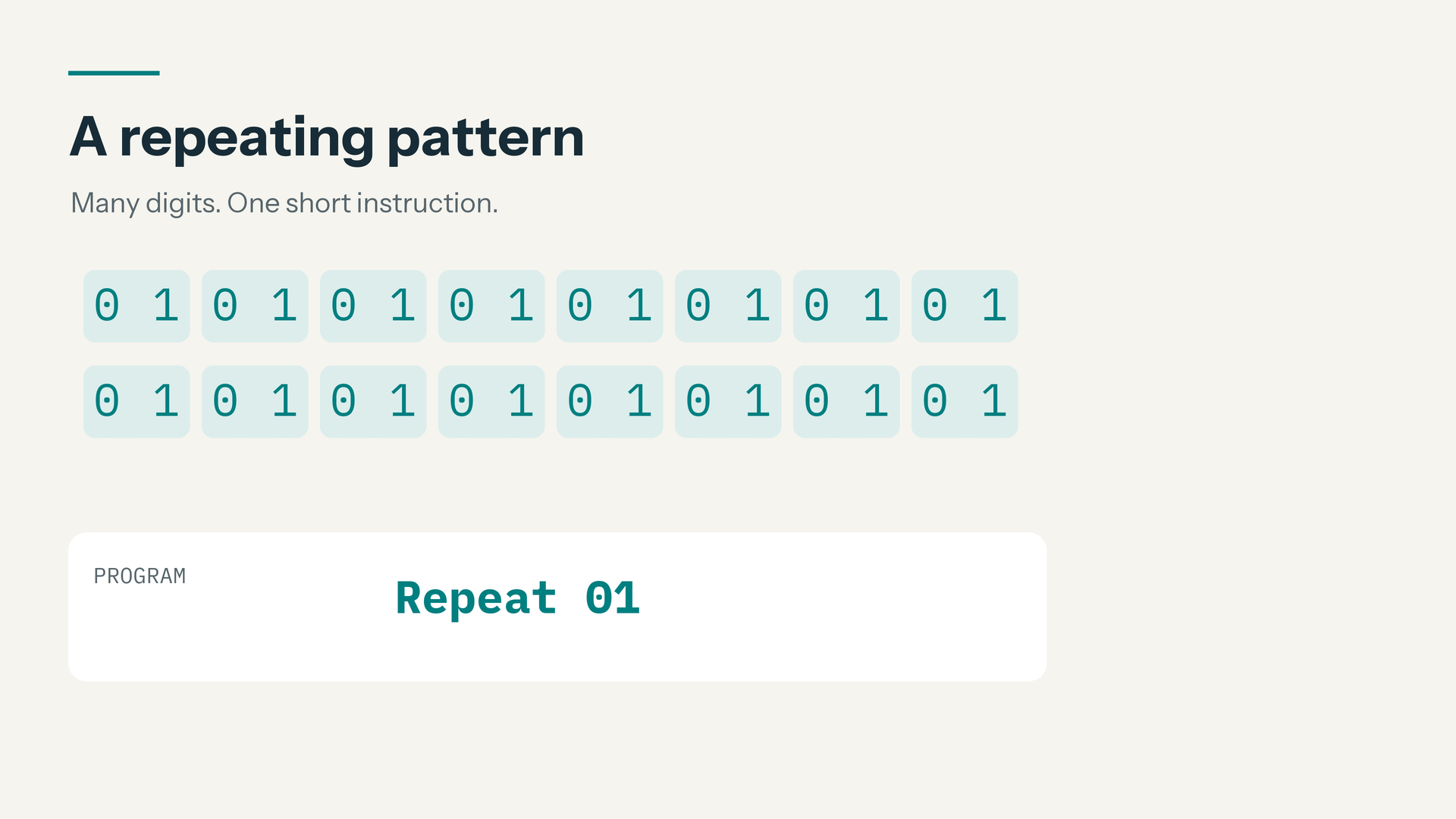
Imagine you have a string that goes zero, one, zero, one, zero, one, zero, one. Essentially, the ones are in the even spots. You could say this is equivalent to a set consisting of all the even numbers. That’s not a very complicated set. It’s easy to describe.
Formally, there’s this thing called Kolmogorov complexity. If you want to quantify how complex a set of integers is, or a binary string, which is equivalent, you say, “What is the shortest program that could generate that?” That’s fairly straightforward. It’s a short program.
Technically, when you want to measure the length of the program, since there are so many different programming languages, you formally think of it as a universal Turing machine, which is this very primitive way of computing. You say, “What is the shortest input to a universal Turing machine that would output that string?” Really, the technical details don’t matter. The idea is you want to understand the complexity of a string.
If you think a little bit about it, you realize this measure makes sense until it doesn’t. Let me tell you first how it does make sense, and then why, at some point, it stops making sense in its usual definition. Compare a string in which the ones are the even numbers to a binary string in which the ones are the perfect squares.
The perfect squares are a little bit more complex than the evens. The concept is a little bit more complicated. If you’re writing a program for it, you could imagine it would be a little bit longer than the one for the evens. Then let’s talk about the prime numbers. The prime numbers as a set are maybe a little bit more complex than the squares. You can imagine more and more complex things like that.
It’s all a matter of how long the description of that string is. So far, it all sounds good. Things get more complex, more interesting, more sophisticated—all those good things.
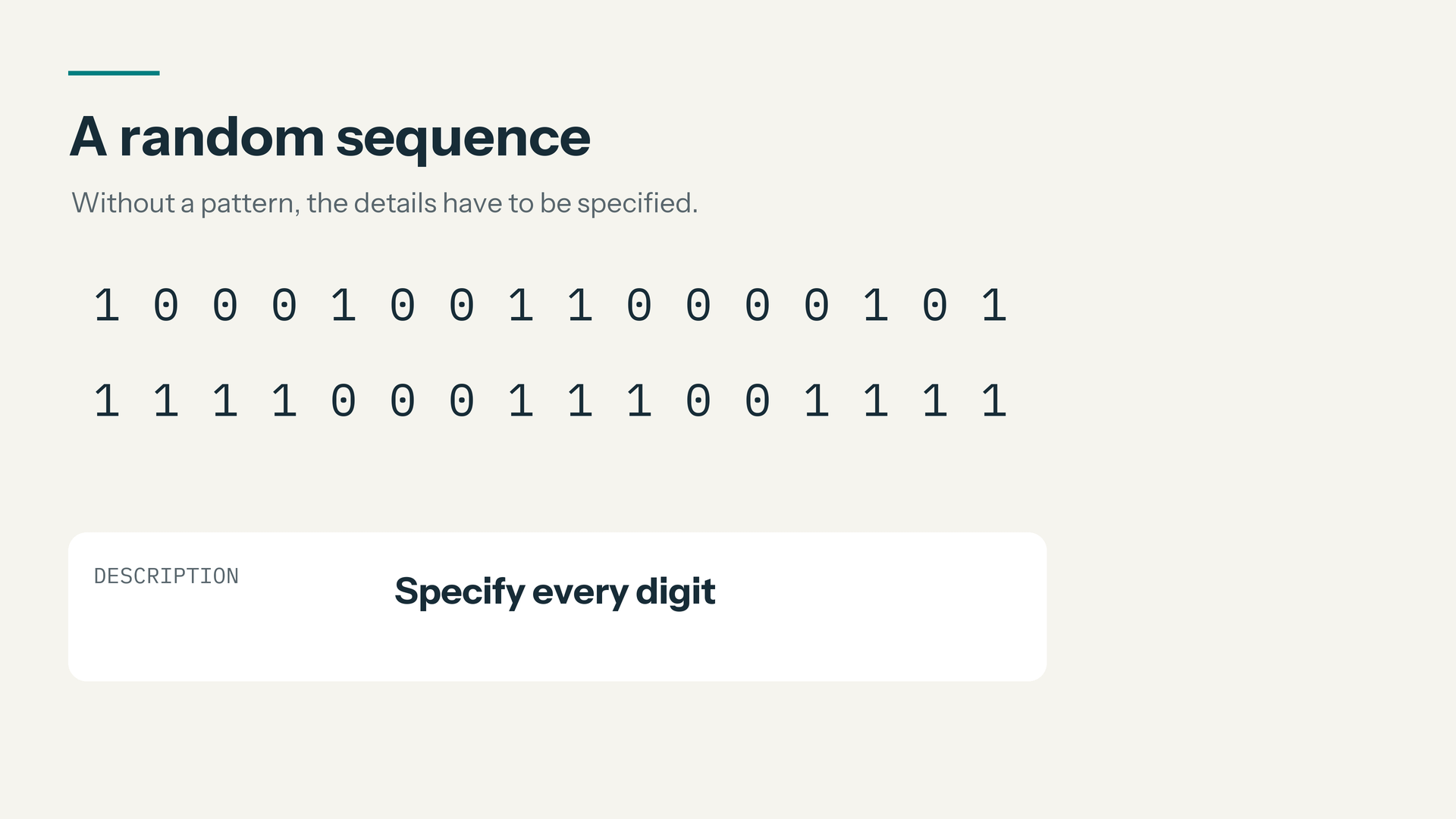
But now, suppose I took a string that was completely random. Just zeros and ones—I’m throwing them out there. What makes it random is exactly the fact that I have no way of shortening it, because there’s no pattern in it. The easiest way to describe this completely random string of zeros and ones is to give you that exact string. In principle, using this definition, that’s the most complex possible string you could have.
But if what you’re really interested in is “How deep is this?”—squares are a deeper concept than evens, and primes are a deeper concept than squares—you don’t really think some random string is deeper than the primes, or things that are even deeper than that. It’s just random junk. The classical definition of program-length complexity, or Kolmogorov complexity, fails over there. That’s where it doesn’t match your intuition.
There’s a trick for overcoming this. The idea is you say, “It’s not that I want the shortest description of the string. What I want is a description that consists of a program and an input to the program—a random input to the program.” That’s my description. For the squares or the primes, you’d actually write a program that generates the squares and the primes.
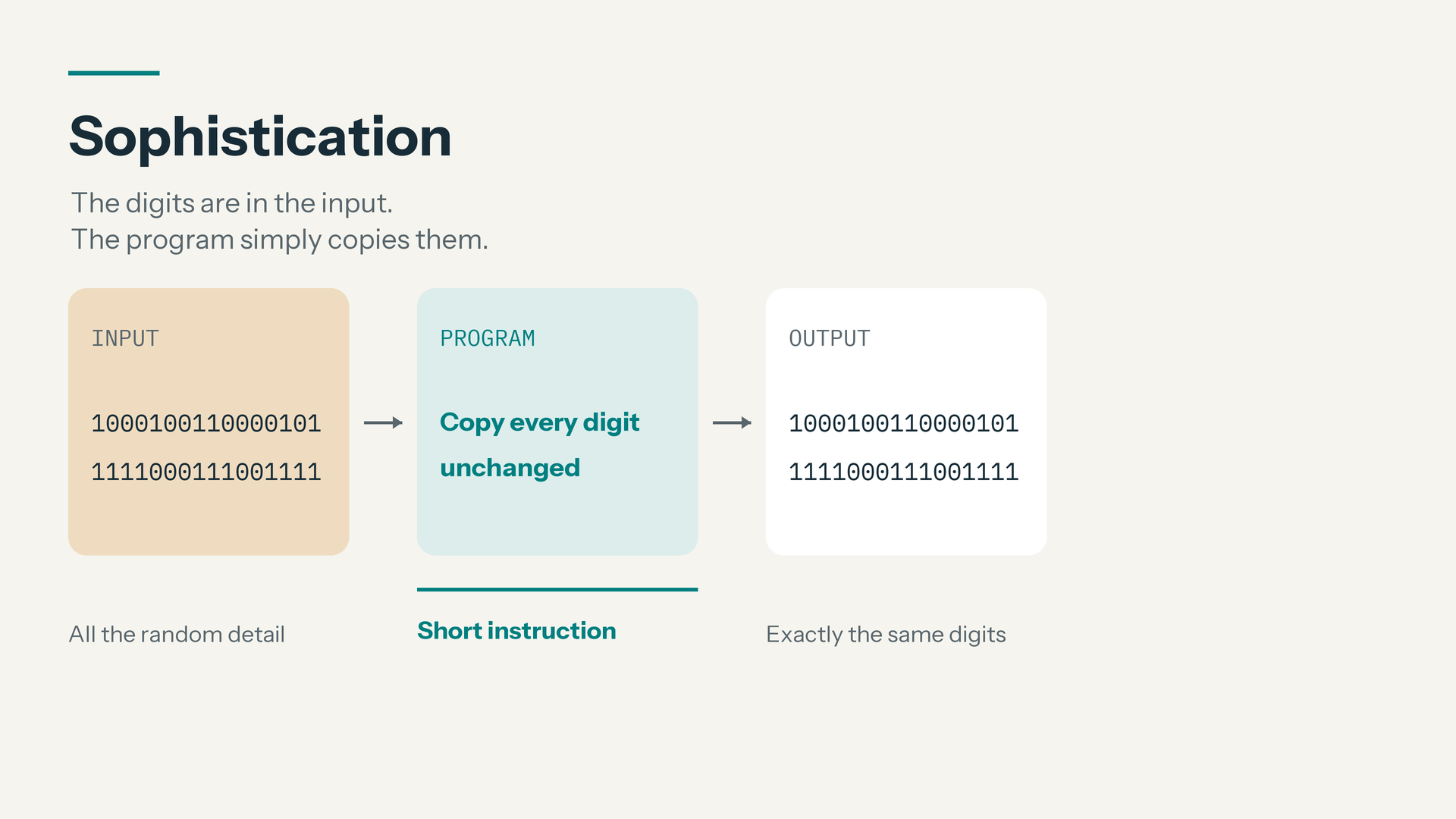
For a random string, your program would be very trivial. It would say, “Print this,” and your input would be this random thing. You need all kinds of constraints to make this work the way you want it to, which we needn’t get into. But the upshot is that it’s the length of the program part of the two-part description that’s called sophistication.
When you do it that way, the squares are more sophisticated than the evens, the primes are more sophisticated than the squares, but the random string is actually not sophisticated at all, because the program part of the two-part description is very short. It’s just “Print this.”
Ariel (06:21)
Is there always such a clear way to distinguish how deep something is? What if you have a program that’s very complicated, but it just generates a pseudorandom number? Is there some way you could really tell that one program is deeper than the other?
Moshe (06:35)
Yeah. The answer is that this whole definition is completely theoretical, because computing the sophistication of a string the way I described it is itself not computable. You can’t actually do it. It’s just a completely theoretical definition.
Of course, it runs up against all kinds of things. For example, if you’re thinking of your two-part description—the program and the input—as both being inputs to a universal Turing machine, it depends which universal Turing machine you use. You can translate any universal Turing machine into any other universal Turing machine in a finite number of bits, so they can’t differ by more than some constant, which depends on the particular two universal Turing machines you’re using.
All this is highly theoretical. It’s not something you’d actually use in everyday life.
Ariel (07:32)
Were you drawn to this as part of your exploration of math, or was there something about trying to explain what meaning is that drew you to this concept?
Moshe (07:39)
Yes. It was completely about trying to explain what meaning is. I had all kinds of motivations for doing this. One is that I think a lot of mistakes people make in thinking about fundamental issues like determinism, free will, and creativity are rooted in bad intuitions.
One of the bad intuitions we have is that everything that can be generated in the real world, or can exist in the real world, must be some recursive string, or computable. It’s something that follows a pattern. Eventually, people wake up and say, “No, that can’t be, because there’s random stuff, and that’s not recursive. It’s not a computable thing.”
Then they come to the conclusion that everything is really just a combination of something that’s computable and something that’s random. They can imagine a string where all the evens are ones, but all the odds are just random junk. If you get trapped in the thought that that’s all there is, you begin to think, “Well, there’s no real meaning, because everything is either completely deterministic or completely random.”
What I wanted to show—and this is also in my book Meta-Halakhah—is that there are, in fact, strings where, if you look at an infinite string as it grows, it’s not just some deterministic aspect sitting on top of some random thing. As it gets longer and longer, you keep finding that the shortest program you could have keeps getting longer.
You have increased sophistication as you go out to infinity. Something could theoretically have infinite sophistication, which gets you beyond that trap of determinism and randomness. It’s a very good intuition pump for getting past certain traps that make you believe there’s no real deep meaning in the world because everything is either cranked out mechanically or random.
Ariel (09:46)
So where do things come from if they’re not mechanical or random? What’s the source of the complexity?
Moshe (09:51)
That I can’t tell you. My point is only that you have no analytic argument for saying that such things can’t exist. But where they would come from, that’s beyond me.
Ariel (10:09)
The idea mathematically is that as you increase the length, there’s always some way to compress it, but the program you need to compress it always gets longer. Is that the basic math?
Moshe (10:17)
Correct. That’s exactly it, yes.
Ariel (10:20)
You mentioned your book Meta-Halakhah. I actually have it right here.
Moshe (10:25)
Yay.
Ariel (10:26)
When you apply it to these broader realms, is it more like an analogy from the mathematical ideas, or do you think the same ideas really apply in the real world?
Moshe (10:35)
It’s mostly an analogy. As I said, I like to think of it as an intuition pump more than anything else.
Ariel (10:44)
Is this ability in the real world for unlimited sophistication something that’s unique to humans, or would it happen in other places also?
Moshe (10:57)
I don’t know the answer to that. Again, for me, this was all an existence proof. It also allows me to make sense of things without making any strong claim.
For example, I use it as a homiletic tool. In rabbinic thought, there’s a lot of talk about the expansion of Torah. What does that mean? Does it all come from certain basic principles? That seems to contradict the way Jews have traditionally thought about halakha as something that always has some new creative aspect to it. Clearly, they don’t think of it as random, or even some combination of the two.
This is a nice homiletic tool for explaining all kinds of claims. But I don’t want to push it beyond a homiletic tool. I don’t want to make strong claims about how the world works, because I couldn’t possibly tell you how these things would get generated.
Ariel (12:03)
I think in the book you mentioned how part of the purpose of halakha, or Jewish law, is to increase sophistication.
Whether that’s meant literally or homiletically, I guess the question is: what’s so valuable about increasing sophistication? I could imagine people having lots of complicated rules without accomplishing anything. Maybe someone else has just a simple rule, “Love your neighbor,” or whatever it is, and they’re happy and flourishing. What’s special about additional sophistication?
Moshe (12:32)
Again, you don’t need to think of it in this context as being super special, just as a way of explaining claims that each generation adds some sophistication. But is that better or worse in some way? We’d have to start with: what would be our measure? What are we trying to optimize?
You hint at the idea that maybe there are things we could optimize by keeping things simple rather than making them more complicated, and I’m not going to argue with you on that.
Ariel (13:09)
Turning to your more recent book—it’s still been a few years, I guess, since you published it—you published Judaism Straight Up,
Moshe (13:15)
Right.
Ariel (13:15)
which aims to explain the value of religion in modern times. Could you briefly describe the goal of your book and who it’s addressed to?
Moshe (13:24)
The book is mainly addressed to people who have an interest in Jewish law in any case, but may have found it to seem somewhat arbitrary, or may assume it requires belief in certain claims that seem to them to be dubious. I’m trying to give what I think is maybe a deeper explanation of how religion in general works, and in particular how Judaism works.
Ariel (13:55)
Could you explain what you see overall as the value of tradition and traditional societies?
Moshe (14:02)
Sure. What I argue for in the book is not all the possible value you can get from religion, but rather one thing you can get from religion, which I regard as a necessary condition for any culture: it has to be adaptive so that it can survive under different conditions.
In order for it to survive under different conditions, the society obviously has to have a degree of solidarity and cooperation that would hold it together. I think you’re alluding to the main claim in the first part of the book. Let’s take a step back.
Jonathan Haidt, in The Righteous Mind, made what I think is a very strong and correct claim: there are two ways of thinking about morality. Some people have essentially a single moral flavor, which is “Be nice.” It’s fairness; it may go beyond fairness to charity and kindness. That’s one flavor that’s universal. But more traditional societies also have other flavors. He’s got five or six; I think three is enough to capture the idea.
The additional two flavors beyond fairness are, one, “Be loyal to your tribe.” Your tribe might be a unit as small as the family or as large as a nation. The idea is that you should be loyal to the tribe. The other is what I call restraint: there are some things you just don’t do. You can’t eat that, et cetera. There are just things you don’t do. So he’s got loyalty and restraint.
In modern societies, or certainly in progressive societies, fairness seems to be the dominant moral flavor. The idea of tribal loyalty, and the idea of not being able to do things that don’t have an obvious reason for being forbidden, offends people somehow.
He claims that people actually instinctively feel all three flavors. If you talk to people about cannibalism, which is not obviously unfair, assuming it was all done by agreement, it’s not obvious why somebody who has only the one moral flavor would regard that as a bad thing. But it does seem to be the case that most people in non-cannibal societies regard it as a bad thing.
Since I’m writing in defense of Judaism, my claim here is that Judaism does have all three moral flavors. That’s quite clear. There are many things you can’t do in Judaism that seem quite arbitrary, and it certainly requires a strong degree of tribal loyalty.
Let’s nerd out a little bit, since you like to go in the math direction. Let’s go in a math direction for this one. Think of interactions within society as essentially a repeated prisoner’s dilemma.
There are many equilibria in repeated prisoner’s dilemma. There’s a folk theorem that says, basically, there are many different strategies that are all equilibria: you do what you do, I do what I do, and neither of us would have any reason to change our strategy. But many of these actually lead to very bad results.
The strategy that we both use that would lead to optimal results, and that is an equilibrium, is called tit for tat. We both start out cooperating with each other. If you cheat, then I cheat back. But if you’re playing tit for tat and we both started out nice, the end result is we’re going to cooperate the entire time, and we’re going to maximize utility. So tit for tat is the right strategy.
It turns out that in order for tit for tat to work, you need several conditions that happen to match exactly the three moral flavors. Haidt doesn’t say this. This is my new idea, and it kind of works really well. The idea is this: when does tit for tat work for both of us?
If we both have low discount rates. In other words, if one util—one unit of utility—a year from now is worth slightly less to me, let’s say 0.9, than one unit of utility today, I’ve got a low discount rate. If it’s worth 0.001 of a unit of utility today—that is, what happens a year from now hardly interests me at all—I’ve got a high discount rate.
If I have a high discount rate, it’s not optimal for me to just keep tit for tat. I’d rather start cheating on you. Why? Because I’ll take advantage of you now, and the price I pay when you take revenge is going to be down the road. It’s worth it to me to cheat you if I’ve got a very high discount rate.
In order for this to work, the first thing we need, for us to use tit for tat as our initial strategy, is that we care about fairness. Tit for tat is almost the definition of fairness. The universal moral flavor comes into tit for tat right at the beginning, and that’s clear.
However, I also need to have a low discount rate. When do I have a low discount rate? Basically, if I’m able to restrain myself. I’m the kid who doesn’t eat the marshmallow so that I get the second marshmallow later. That’s essentially what it means to have a low discount rate. I can wait to get a bigger profit later. That’s where the idea of restraint—there being all kinds of arbitrary things you don’t do—comes in.
But that alone is not enough either. In order for the two of us to carry on a long-term relationship where I’m selling you stuff, or you’re selling me stuff, and we’re paying on credit, and you want to make sure the other person isn’t running away with the money before they deliver the goods, you need to show that you’re a good type.
Eric Posner has a whole lot of articles about this: the importance of signaling that you’re a good type. One way you do it, for example, is you give presents to people. A seller gives the buyer a present because he wants to keep him as a buyer, and it’s only worth giving him a present of that size if he’s expecting a long-term relationship.
In general, the way we signal these things is essentially through different ways of proving loyalty. In order for this whole thing to work, we need, first of all, fairness, because we both adopt tit for tat. Second, we need restraint so that we have low discount rates. Third, we need to send signals to each other so we each know we’re the good type that can carry on a long-term relationship. That’s essentially a form of loyalty.
My claim is that society, if you break it down way too formally, is a bunch of repeated prisoner’s dilemmas, and the way to make it work is by having all three flavors. To put this in a less nerdy way, the reason we need to have crazy rules that don’t make sense in any obvious way is so that we signal to each other that we’re good types and can be trusted. That’s the point.
Ariel (22:08)
I guess that raises a question. There are many societies that don’t have such extensive ritual rules. Certainly in modern times, you go to Switzerland, Scandinavia, and many different places, and they seem to have well-functioning societies. What’s so essential about having all these different rituals if societies can function well without them?
Moshe (22:29)
Right. I’m not going to make enemies in Switzerland or Denmark, or whatever it is. That’s the last thing I want to do. I’ll only say that in order to prove adaptiveness, which is what we’re really talking about here, you need to survive lots of different conditions. You need to survive a complete lack of environmental stability.
The Jews have certainly done that. Whether the Swiss or the Danes or whoever can do that, I don’t know. I’m sure they’ve had their travails, probably fewer than the Jews. But the question remains: how adaptive are they under different circumstances which they have not yet faced?
Obviously, I don’t know the answer to that. The purpose of my book was not to be nasty to the Danes. It was to say good things about the Jews who have managed to survive under very adverse circumstances.
Ariel (23:30)
Is the goal just to survive, or is there some other goal that all these rules—
Moshe (23:35)
Right.
Ariel (23:36)
—are aiming at?
Moshe (23:37)
Survival is the easiest thing to measure and to make my formal case about. But obviously we’re looking for more. We want to have a good society, and my claim is that cooperation and adaptiveness are exactly what characterize a good society.
To be fair, a religious person would say to me, “No, I think the point of religion is way beyond having a good society. I think the point of religion is to worship God and all kinds of exalted things like that.” My response is, “That’s perfectly okay.” I was giving a set of necessary conditions, not sufficient conditions. It may very well be that there are other purposes to cultural norms.
Ariel (24:23)
Turning for a second to what the religious person would say: because you’re giving these external benefits, what would you say are the minimum required beliefs for the religious person themselves to commit to this? Is it just, “Yeah, Jonathan Haidt,” and they’ll follow it and pass it to their children? Or are more beliefs required for it all to work?
Moshe (24:43)
That’s an interesting thing. I have a whole chapter in the book where the whole point is to minimize what needs to be believed. But I don’t like to spell that out. I’m kind of oblique about it, and I’ll tell you why.
I think religion is good for people, and I want to encourage them to be religious. I’m not getting up on a soapbox, but I think it’s a good thing, and I certainly don’t want to talk them out of it. There are different types of people in the world. For some people, having very specific beliefs is really important. That’s what they need, and they’re able to have them. They’re prone to having very specific beliefs about how the world works, even without a lot of evidence, and that’s a perfectly healthy thing.
Other people find all these kinds of beliefs extremely improbable, and they’re the types of people who cannot commit their lives on the basis of improbable claims. For them, the right thing is to make the case that religion does not actually require very much belief.
Depending on who you’re talking to, you may want to say, “Look, you don’t really need to believe all that much,” or you may want to say, “Carry on believing everything you’re believing, because that’s what you need.” Since I’m talking here to an undefined audience, which presumably includes people of both types, I don’t want to say the wrong thing to anybody.
In any event, the gist of it is that I think there are certain required beliefs, but the required beliefs are essentially that history is directed, and that your particular culture will survive and thrive if people stick to it.
If you think about Jewish beliefs—and I certainly don’t want to get into the weeds of Jewish belief here, since there may be people who have no interest in this topic whatsoever—essentially, the point of Jewish belief always involves Jewish law, halakha. Halakha is kind of the topic of Jewish belief.
Different authorities have given different numbers of canonical beliefs. But if you took them all and distilled them to the essence, it’s this: Jewish law comes from somewhere. That’s what it means that the Torah was given at Mount Sinai. It comes from somewhere. The other belief is that doing the right thing is rewarded and doing the wrong thing is punished. The third is that the society of people who abide by these laws will eventually lead toward some kind of messianic redemption. These are the basic beliefs.
If you think about it, first, all the beliefs involve Jewish law. It’s the topic of the belief. Second, they’re all saying essentially the same thing: this is a directed process. It’s evolving in a positive way. It started in a non-arbitrary place, and it’s moving forward toward something.
I think that’s something that’s easy to believe. I don’t think it’s hard to convince yourself that strong societies doing the right thing move forward.
Ariel (28:25)
I guess the question is: are those beliefs enough for a society to continue following all those rules?
If you take an extremely religious group, they have much stricter ideological rules. They don’t question belief, they don’t allow any questioning, and they have lots of children. Maybe by your definition they’re considered very adaptive, so to speak, because they’re having lots of children and continuing to follow the rules.
But if you go in a more open and more liberal direction, people are more open to different beliefs, and they might question things more. Would a society really continue following all those rules if they believed such a minimum set of beliefs?
Moshe (29:03)
My minimum is not zero. My minimum is considerably above zero. Again, there’s kind of a slider from abstract to concrete in defining these beliefs. I think every person has a different minimum level of concreteness they require for this to work.
I think it’s perfectly possible for a fairly low level of concreteness and a high level of abstraction to work quite well. The place where I think it can’t work is not these formal kinds of beliefs, but rather the degree of separation people require for their communities from the larger community.
If people don’t build walls at least to a reasonable height, they have, at least in open societies, very little chance of getting too far—that is, continuing for too many generations without being assimilated.
Ariel (30:06)
So you’re saying it’s more about having distinct practices that keep the group separate than having very specific, detailed beliefs?
Moshe (30:13)
Yes.
Ariel (30:14)
When a religious group is working out what rules to follow, what process do they use to determine what’s true to their ideals and what isn’t? How does that unfold?
Moshe (30:25)
The second part of my book is exactly about that. The point is that the system has to be designed, first of all, to evolve very slowly. That’s exactly what I think it takes to be adaptive.
It involves a combination of bottom-up intuition about what should work—that is, traditions evolve, not necessarily because some authority said this is the way it should be, but very often because of things the society itself, maybe without having thought it through very carefully, just decided to do—combined with authorities who are very big experts saying, “This is what I think you ought to do.”
Even that’s a bottom-up thing, because determining who’s an authority worth listening to is something that comes from the bottom up. One person becomes an authority, not because he gets appointed to the position, but because many people have accepted him as an authority.
If somebody seems really smart and looks like they’re likely to get the right answer, people start paying attention to them. When people pay attention to them, the way this dependency plays out, they’re essentially getting more weight. Effectively, when you have a society that works bottom up, but people imitate those who are apparently very smart, you get the effects of a weighted majority vote. Things have a chance of moving in the right direction.
Ariel (32:00)
A very traditional religious person has a very clear goal. They’re trying to understand what the original meaning was, what the divine intent was in specific rules. What do you view as the actual goal everyone’s aiming at? When you say “the right answer,” what does that mean?
Moshe (32:17)
For me, it’s a little bit circular, because the right answer is the answer we converge to using this kind of messy process. Yes, you’re hinting at a certain circularity in the way I’m thinking about it. If you don’t think there’s a true answer up in the sky, then what is it we’re converging to? If you think it’s all convention, then by definition, whatever we converge to is true. I think the answer is somewhere in the middle.
People ask on every subject, “Are we inventing it or are we discovering it? Is the truth out there and we’re finding it, or are we inventing it?” People even ask that about mathematics. You can ask it about almost any field. Certainly in the field of law, there are those who think there’s a right answer out there. These are famous debates between Dworkin and a whole bunch of other law professors.
I think that when it comes to Jewish law, there is a right answer. This is not a theological statement. It’s just a statement about legal systems in general. When you have enough answers to enough questions, but there are still open questions beyond those, there is a natural generalization from the known questions to the open questions. Sometimes the natural answer is obvious, and sometimes the natural generalization is not obvious.
I think it would be a false dichotomy to ask if this is completely conventional or if we’re actually discovering the truth. I think the answer is somewhere in between.
Ariel (33:58)
In general, do you think religious groups, especially ones that have all these rules and beliefs, are adaptive and flexible enough? Sometimes there are certain rules where we know why they came about, the reason doesn’t apply—it hasn’t applied for over a thousand years—and they still follow them. Where’s the great adaptability there?
Moshe (34:18)
Again, you’re defining adaptiveness differently from the way I’m defining it. You’re saying that, on a first-order examination, it looks anachronistic. That’s not the definition. For me, the definition of adaptiveness is using strategies that will aid your long-term survival.
It may be that you’re doing things now that once made sense but now seem completely arbitrary. But those arbitrary rules serve the function of signaling, for example, which we discussed before is very important for society. If everybody agrees to do the same weird thing that doesn’t have any obvious utility, there’s nevertheless a tremendous benefit to that.
Also, if people keep rules about things they’re not going to do, even though you say, “Well, what’s so bad about eating a fish that doesn’t have fins and scales? It doesn’t seem like it’s going to change the moral universe,” nevertheless, it is a way of practicing constraint. It gets you to learn how to defer pleasure and therefore to have a low discount rate in life in general.
Ariel (35:37)
Could a person just follow a different set of rules, like health rules or something? Or do they have to follow specific—
Moshe (35:41)
I think the point is that in order for it to have the right effect, you’d have to have a whole society agreeing on the same rules. A deeper question you could ask is: imagine a society that would make up a whole bunch of arbitrary rules. Could that work?
Here’s an interesting fact. There were lots of communes. In the early twentieth century in the United States, for example, communes were a big deal. They all had rules, but some had very few rules, and some had a lot. The rules were sometimes very arbitrary, and there are records of how long these communes actually survived.
This is a miniature experiment. None of them survived for very long. None are still around now, but they did survive for generations in some cases, and others broke up in a year or two. A guy named Richard Sosis, a sociologist, investigated this. He had the records of their rules and how long they survived. It turns out that the more crazy rules you have, the longer these communes survived.
That’s not a proof of anything about larger societies and religions over centuries and millennia, but it’s a nice bite-sized experiment that illustrates the point, I think.
Ariel (37:07)
You’ve mentioned the value of signaling. It sometimes seems religious groups, maybe partially due to signaling, just add more and more strict rules over time. I don’t even know if they’re trying to separate from broader society, or even within their group to show they’re stricter than other subgroups. Do you think that’s a good thing, or how do you evaluate that?
Moshe (37:26)
That’s a great question. Signaling is a necessary thing for every society. But the more tight-knit a society is—that is, the more members of the society are expected to give each other—the more signals are necessary, because you need to prevent free riding.
Just imagine you’ve got a society where there’s a wedding every night, and basically whoever is a member of the community is invited to the wedding. It’s a free meal. Now imagine you would let every free rider just become a member of the community: “Yeah, you’re fine.” You’d get every bum on earth joining this because they’re giving away free food every night.
How do you prevent that from happening? The answer is that if you’ve got to walk around with a big fur hat on your head in August, and if you don’t do that, you’re just not a member of the community, that’s a good signal. If you’re willing to wear an expensive fur hat, especially if you’re willing to do it in New York City where people think you’re weird, and it’s really hot and uncomfortable, then you’re probably serious about being a member of our community.
That’s as arbitrary as it can be, and the whole point is that it’s arbitrary. If wearing a fur hat made sense because you were in Siberia, it would not work very well as a signal. No harm in wearing the fur hat if I can get the free potato kugel. It’s exactly when it doesn’t make any sense, when it has no utility to me, that it works as a signal.
Ariel (39:02)
Couldn’t they do simpler things, like encourage people to donate? Do they need to make them wear big fur hats? It seems more than necessary.
Moshe (39:08)
Yes, these are very fair debates. Could we get better signals? One of the signals in Israel for certain very strict societies is not getting a secular education, not going to the army, and then not being able to get a job as a result of all that.
That’s a very powerful signal. Everybody knows that if you’ve essentially cut off any hope of making a good living and made yourself an outcast in the broader society, you’re probably really serious about being a member of this community. It’s a fantastic signal, but it’s so costly. The whole point of these signals is that they have to be costly, but it’s so costly that it’s overkill.
It has all kinds of negative externalities. If a whole society doesn’t get an education, doesn’t go to the army, there are negative externalities to this for everybody. It may be that, on the whole, if you consider the advantages and disadvantages of these signals, it’s a net loss.
Sometimes these signals carry over from other societies where they were more necessary to a society where they’re less necessary. They’re still extracting the cost, but maybe they’re not getting the benefit. So I agree. Signals sometimes evolve a little bit slowly, but it may be that, on the whole, it’s better to evolve too slowly than too quickly.
Ariel (40:43)
We touched on this a little bit, but if someone is raising children, or society is shaping the next generation and the values they have, what do you think their overall goal is? Is it that they should follow their different beliefs and ritual practices? Or is it a broader goal where they want people to be happy and flourish? What goal are they all aiming at?
Moshe (41:02)
I think these things go together. The proximate goal is to stay loyal to the community by keeping all the rules and doing all the rituals. But the larger goal is to have kids who grow up into adults who have a sense of purpose and direction in their lives, which ultimately brings a kind of satisfaction that mere material goods can’t bring.
Ariel (41:35)
In your book, you have a character, Shimen, who—
Moshe (41:38)
Yeah.
Ariel (41:38)
—kind of represents these ideal traits of no gimmicks, just following tradition. What do you—
Moshe (41:43)
Yeah.
Ariel (41:43)
—think he would think of your book?
Moshe (41:48)
I think about that a lot: what would Shimen think of my book? The answer is that Shimen would say, of course in Yiddish, but I’ll say it in English, “Why are you wasting your time writing stories about me? Why don’t you sit down and just learn a page of Gemara?” That’s what I assume he would say. He was just that kind of a guy.
But I think, really, he would appreciate that I captured him in the book. I hope I did.
Ariel (42:20)
Do you think he would care about any of those arguments? Or he doesn’t care about all those—
Moshe (42:24)
No.
Ariel (42:25)
—arguments?
Moshe (42:27)
Of course not. Of course he doesn’t care about any of those arguments. The point is that he lived within this community and according to its rules in a completely comfortable way. The guy was totally comfortable in his own skin. He didn’t feel like he needed to justify himself, and that’s exactly what I admired about him.
But of course, I’m busy here writing a whole book attempting to explain him and justify him. Maybe I didn’t get that benefit. I’m maybe too self-aware. Maybe I’d be luckier if I were more comfortable in my own skin like Shimon was.
Ariel (43:01)
So maybe, in your view, the ideal is really to not think about these things and just live it without questioning it?
Moshe (43:06)
No, that depends on your circumstances. I don’t have the option of not thinking about them. When you grow up on the Upper West Side of Manhattan, as I did, I don’t really have the luxury of not thinking about this.
Every moment of every day, you’re facing the very obvious tension between the society you live in and the broader society that serves as the backdrop and the environment in which that society lives. That’s a luxury I think most of us don’t have.
Ariel (43:43)
Now—
Moshe (43:43)
Yeah.
Ariel (43:43)
—turning to a little bit of a separate topic. You’ve done a lot of research into authorship detection. Can you tell me a little bit about what your work established and what you were able to demonstrate using algorithms regarding the authorship of texts?
Moshe (43:59)
Sure. The idea is you have an anonymous text and you’d like to know who wrote it. In the vanilla case, that’s easy: there’s a small number of candidate authors. You want to know whether this play was written by Shakespeare or Marlowe, to take a famous historical example. You have plenty of plays by Shakespeare, and you’ve got plenty of plays by Marlowe.
Now you’ve got play X, and you want to know what to do with it—Edward III, for example. The basic idea is you want to know the characteristics of Shakespeare’s plays. What do they have in common? What are the characteristics of Marlowe’s plays? Then you come up with a formula that distinguishes them.
Think of a plane. Just think of a blackboard, and think of each one of Marlowe’s known plays as a point on the blackboard, and each one of Shakespeare’s plays as a point on the blackboard. In principle, you want to find a line such that all of Shakespeare’s plays are on one side of the line and all of Marlowe’s plays are on the other side. Now you take X and say, “Which side of the line is it on?” Now you have the answer.
That’s a classic example of a classification problem, or more specifically in this case, a text categorization problem. The techniques were developed in the nineties and the two-thousands by me and a whole bunch of other people.
The game eventually becomes fairly mechanical. You want to know what kinds of features to look for. The frequency with which each author uses various words might be the most basic feature you’d use. Shakespeare often uses the word “doth”, and Marlowe uses it less, but Marlowe uses the word “wherefore,” and Shakespeare uses it less.
Obviously, one word doesn’t prove anything. That’s what amateurs think: “I found a word that’s the smoking gun.” It never works that way. You look at hundreds or thousands of features like that, and the frequency in each document for each of these people, and then you use machine learning techniques.
In the old days, you would use things like support vector machines or whatever. Now those are out of fashion. People tend to use neural nets for almost everything, just because they seem like magic. But between you and me, neural nets are magic only if you’ve got a gazillion examples. If you have a small number of examples, neural nets are not quite magical, and you’re probably better off using one of the old-fashioned techniques.
In any event, you use these machine learning techniques after finding some formal representation of each document. You find the optimal line.
But then there are a million variations on this. Sometimes it’s not, “Is it Shakespeare or Marlowe?” It’s, “I have no idea who wrote it, but it might be Shakespeare. Just tell me: is it Shakespeare, yes or no?” That’s already much harder. That’s not a classification problem; it’s called a verification problem. Just give me a yes or no: was it written by Shakespeare? It’s a much more difficult problem to solve. I developed some techniques, and others have developed techniques, for solving those kinds of problems.
Then there are variations where, instead of asking about individual authors, you want general information about the author. Tell me if the document was written by a man or a woman. Tell me if it was written by somebody young or old. Tell me if it was written by somebody whose native language is English, or maybe German or French. You might want to do a demographic analysis.
If you have no idea who the author is, you do a demographic analysis, and you could narrow it down to a male in his thirties whose native language is French.
Ariel (48:04)
What’s an example of an interesting finding you had using this research?
Moshe (48:08)
There are a whole bunch. One is that, surprisingly, you actually can tell the difference between men and women, even in scientific writing. With about eighty percent accuracy, you could tell if the author was a man or a woman. That’s pretty astonishing.
The way you do it is you test yourself on documents where you know the answer, but you didn’t tell your algorithm about this document. You run your algorithm on it and see if you get the right answer. It turns out that men and women could be distinguished with approximately eighty percent accuracy. That’s a very surprising result.
I also applied it to a whole bunch of classical Jewish texts. I discovered, for example, that Rabbi Yosef Chaim of Baghdad, otherwise known as the Ben Ish Chai, actually wrote a book that he claimed to have found in the cellar. It’s been disputed whether he really found it or actually wrote it. I got very strong results using some of these verification techniques that he wrote it for sure. That’s an interesting result.
There were some letters, supposedly by early Hasidic rabbis, that would have been worth a great deal of money. They were supposedly found in an archive in St. Petersburg after the Russian Revolution, and I proved they were all forgeries.
Ariel (49:36)
Interesting. I think at some point you also pointed these algorithms at biblical texts. Do you want to talk a little bit about that and what it helped demonstrate?
Moshe (49:46)
Yeah. I was always loath to work on biblical texts. That’s really getting a little bit close to the core of the nuclear reactor there. But I defined a new problem, which is this: take a text that was written by multiple authors, where each wrote some of it, but you don’t know who wrote which paragraph or chapter or whatever. Can we do an analysis of stylistic shifts and break it up in the most natural way?
I should say you can do this to any document. You can apply my technique to a document written by a single author and say, “If you were going to break this up into two, what would be the most natural breakup, so that the two parts are most internally coherent, but most different from each other?” You can do that to any document.
I did this to the Bible, the first four books of the Torah. When you do this, you actually find that the algorithmic method kind of matches what the Bible critics called the P, the priestly sections, and the non-priestly sections, which are then further broken down.
That shows the critics are pretty clever. It doesn’t prove they’re right. It certainly says nothing about the divine origins of the Torah or anything like that, because we don’t have any priors on God’s style. If somebody wants to go that route, I don’t think this is relevant to that at all.
We also found that the J and E breakup—the non-P breaks up into J and E—has no algorithmic confirmation whatsoever. I’m told that’s actually now out of fashion among Bible critics as well.
That was an interesting thing. Again, I would warn people not to read any deep theological meaning into this. But I think it does say that the people who worked on this in the past without algorithmic methods were quite clever.
Ariel (52:01)
How did you feel when it matched up with some of what they said? Was it like, “Great, my algorithm’s good”? Or was it like, “No, they were right about some things”?
Moshe (52:09)
No, it was more like, “Great, my algorithm is good. I think I can publish this paper.” Maybe that was a heretical thought on my part, but that’s how I reacted.
Ariel (52:22)
In terms of the religious implications, you’re not bothered at all by it? Even if one doesn’t know how a divine text would be written, you wouldn’t guess it would match up with how two different authors would write a text. It still raises some theological questions.
Moshe (52:35)
Why not? For me, it didn’t bother me very much at all. Why shouldn’t there be two different styles there? You can read meaning into that as well. You could say, “Well, yes, the reason there were two different styles interacting here is that there’s some deep message there. Go find it.” That didn’t offend me at all.
Ariel (52:59)
Since it’s this constantly unfolding process, is there any implication that, when you go back, even the formation of the text itself could have developed through some kind of process as well?
Moshe (53:14)
Here I’m a traditional guy. I’m willing to go with the traditional beliefs on this. I have no particular reason to do otherwise.
Ariel (53:25)
Pivoting, do you have thoughts about how to view large language models? They seem to have almost unlimited capability. Do you have any thoughts about where the intelligence comes from? Is it parallel to the evolutionary process, or how the brain learns? Where do you think the abilities within a large language model come from?
Moshe (53:47)
The point is that they’ve essentially encoded a humongous—I mean, really humongous—amount of text. If you’re able to encode all that, you’re essentially able to simulate the way people write and talk.
Since people are intelligent, if you’re able to simulate the way they write and talk, you can get very far. But that alone, just assigning probabilities to the next word given a text, wouldn’t get you very far.
The point is, if you take the question a person asked—a first-order question, like “Where was Abraham Lincoln born?”—and then treat it as if the query were, “How would you solve this problem? How would you determine the answer?” and generate the answer to that question and then apply that, you get the thinking models they have now.
You can do that kind of trick. Since it can give you the following word for anything, you can play that trick many times. Essentially, you’re not directly answering the question; you’re answering the question about answering the question. You can answer questions about answering the question, et cetera. You can loop that. You can get very far doing that.
I don’t know if that really answers where the intelligence is. Any time you have a network—think about the brain: where’s the intelligence in the brain? Obviously, it’s emergent. It’s not located over there.
Ariel (55:30)
For the AI models, do you think, in a sense, they have either unlimited sophistication or at least much more sophistication than any previous approaches?
Moshe (55:41)
Yes, obviously they do. I’m not going to be that guy who says, “Well, they don’t know how many R’s there are in ‘strawberry,’” and then, of course, a week later they blow past everything you said they couldn’t do. There’s no faster way to lose money than betting against the progress of LLMs. They’re really quite astonishing.
Are they going to come up against a brick wall because they lack physical knowledge? You and I have not only spent our lives hearing and reading texts; we actually navigate the real world and pick up information about the physical world. People are working on that right now, and that will probably be solved using techniques not that different from the existing ones.
I’m very sanguine about the prospects of LLMs getting better, maybe less sanguine about the effects that will have on society. I’m not a doomer, for reasons I don’t want to get into now. Obviously, really bad things can happen, and the Hugging Face incident from a while back is a nice proof of that.
On the whole, I’m more worried about us. I’m worried, first of all, about bad people doing bad things with this kind of power. That’s something we should worry about. Rather than worrying about the AIs themselves taking over and turning us into paperclips, we should worry about some insane guy in the basement who wants to release some biological weapon and will figure out how to do it using an LLM. That worries me more.
But I also worry about whether we ourselves will be tempted to outsource our intellect to LLMs, and we’ll become lazy and stupid. I’m not worried about unemployment the way most people are, which is, “People will be unemployed, they’ll be poor, some people will have all the money, and everybody else is going to be starving.”
That’s untrue, since LLMs clearly increase productivity, apparently exponentially. I think everybody will have a roof over their heads and everybody will have food. It’ll certainly be possible to produce enough of this, cheaply and efficiently enough, that everybody can be taken care of if we have the institutions to distribute it. The real concern is that people have no sense of purpose in their lives.
The example of Rust Belt states, where people who were at the age where they weren’t going to get employed again got laid off in steel mills or whatever, and are languishing in their basements taking opioids and watching TV all day, is not a promising example of what a society looks like when people don’t need to work and can’t find their meaning through those kinds of achievements.
I think we can overcome it, but it’s definitely something we should be thinking an awful lot about.
Ariel (58:44)
What do you think is the role of people as AI becomes increasingly powerful?
Moshe (58:50)
The role of people is to be human, but the question is: what will they need to do? They might not need to do much. But what they should be doing in order to stay human, develop their human potential, be better people, and sustain the human race—all this, I think, is something like what we call Torah lishma, that is, study for its own sake.
I think we’re going to have to develop a culture in which people study, think, and contemplate, whether it’s philosophy or art or something else, for its own sake. Not because they’re attempting to achieve something in this way, but just because it’s a way to develop their own potential. I think that’s the only way our society is going to survive in any reasonable form.
Ariel (59:52)
Is that something most people could see the appeal of? I feel like even in our current world, where knowledge is still practical, or at least it was, most people don’t seem that interested in it. It’s kind of forced on them in schools, and when they’re done with school, they’re done with it. Is that something that—
Moshe (1:00:05)
I know. Yeah.
Ariel (1:00:08)
—you see people in general picking up, just learning for its own sake?
Moshe (1:00:12)
That’s a hard question. I don’t know if it’s possible. They say the definition of heaven is where all the people who love to study sit and do nothing but study all day long, every day. The definition of hell is exactly the same thing for everybody else.
I do worry that most people aren’t fit for that, but I think we would do well to educate children from a very early age to value study and contemplation for its own sake.
Ariel (1:00:50)
I think we’ll wrap up soon, but do you think AI has a role to play here in helping people learn without taking over their ability to think?
Moshe (1:01:00)
Yes, that’s exactly what I’m working on. I have a lab called Dicta that does exactly that. The gist of it is you ask a question about any Jewish topic. It could be as banal as “Why do bad things happen to good people?” or as technical as “What is the opinion of Rabbi so-and-so on the following extremely technical question?” It doesn’t matter; it covers the range.
At the beginning, the way we designed it, it just gave the best possible answer. You ask the question; here’s the answer. Then we realized we were not encouraging people to think at all. In fact, we were replacing their need to think.
We redesigned it so that now it’s a cross between an LLM and a search engine. The first thing you get is a whole lot of sources, and then the explanation isn’t “Here’s the answer to your question,” but rather “Let me guide you through these sources. If you’re interested in this aspect, look here, here, and here. If you’re interested in that, look here, here, and here.”
It’s more like search engine results, but a super-sophisticated search engine that finds anything relevant, whether or not the keywords are mentioned, and then a guide to the literature. Ultimately, the point is I want this to serve as an intuition pump. I want to get the drudgery out of it and make it easy for you to sit and actually think about this, rather than a replacement for your intuition where you just say, “All right, give me the answer. Yeah, great. Thanks, bye.”
That’s exactly what I’m trying to avoid. It’s hard. I’ve actually developed three rules, like Asimov’s three rules, for any tool like this: every single claim you make needs to be sourced; every single relevant source needs to be brought; and you should avoid giving a conclusion. You should just show people the different options. Those are the rules for these kinds of tools.
Obviously, if somebody else comes along and doesn’t abide by these rules and gives you the easy answer, and people are lazy and prefer that, well, I lost.
Ariel (1:03:09)
I think that’s a general issue educational tools are working with. They want to encourage students to think about questions, so they’re always trying to figure out that balance. Do you want to comment briefly, at a high level, on how you designed it?
Moshe (1:03:22)
The basic idea is what’s known in the business as RAG: retrieval-augmented generation. If you ask a question about a Jewish topic, you could just ask Claude or ChatGPT, and they’ll give you an answer. But the answer is not necessarily completely reliable, as you know. Hallucinations are going down, but they still want to keep you happy. They’ll push beyond what they actually know in order not to disappoint you with a weak answer.
They also just don’t have that much knowledge. There are thousands and thousands of Jewish texts available, some fraction of which they saw and are now encoded in the system, but they’re not actually seeing them when they answer you.
Even if they do a RAG-style thing, searching, they’re finding a very small fraction of what’s out there. What we did is beef up all these retrieval methods for getting many more texts. It’s lots of very clever methods, some embeddings-based and some keyword-based, and all kinds of knowledge we bring to bear in order to retrieve these sources.
Once you give a frontier LLM all the relevant sources and say, “Now work with this,” the rest is basically prompt massaging to get it in the right styles and things like that. But the real key to it all is developing these retrieval techniques, and then forcing the LLM to stare at those texts before it gives an answer.
Ariel (1:04:56)
Have you been able to evaluate how your system does compared to Claude or just generic systems? You give it a complex Talmudic question and see who does a better job?
Moshe (1:05:04)
Yeah. I can’t say we have a systematic way of doing it. I would say we have an anecdotal way of doing it. The most systematic thing we do is get answers they gave and answers we gave, then give them to “Fable 5.1” and say, “Which answer looks better to you?”
But obviously, we have experts play with these things and look at them, and people are much more satisfied with what we’re giving now.
There are times when people say, “Claude said something fantastically creative, and you just gave me what all the classical sources say.” We say, “Yes, that’s a decision we made. That’s a design decision. We have sacrificed a certain amount of creativity in order to keep you within the framework of the canonical sources.” That’s a trade-off. We made our choice.
Ariel (1:05:58)
What if the person wants some kind of summary? They don’t want to read through all the sources. Does it also provide that?
Moshe (1:06:04)
You do get a summary, but you can choose its style. It could be advanced: “I’m an expert; give me advanced stuff.” It could be “Just give it to me short and sweet,” or “I’m a novice; give it to me in the simplest possible terms.” We will give you a summary. What we try to do is not default to the summary that makes you work least.
People tell me, “Sometimes I need the answer right now. It’s Shabbos in five minutes. I need that answer now. Don’t complicate things more than necessary.” We do have that option, but we don’t default to it.
Ariel (1:06:41)
Is the idea that if you just give the answer straight out, it’s static, and really the goal is for a person to be part of a more dynamic process?
Moshe (1:06:50)
Exactly. That’s the point.
Ariel (1:06:52)
I think that covers a lot. Is there anything you want to leave listeners with about these overall ideas?
Moshe (1:06:56)
No, this was fun. I think I probably said more than I should have, so let’s not pile on.
Ariel (1:07:04)
Okay, thanks so much.
Moshe (1:07:05)
Pleasure.