

In this episode I talk to Spencer Greenberg about his life philosophy, valuism, and his surprising finding that almost nobody has genuinely harmful intrinsic values. We also get into a worry technique most people have never heard of, why the Dodo Bird verdict is more complicated than it looks, what AI therapy bots get wrong, and why schools don’t teach any of this.
Listen on Spotify or watch on YouTube.
Transcript
Below is a lightly edited transcript, courtesy of AI:
Spencer Greenberg: One of the striking conclusions that we came to is that it seems nobody, or almost nobody, has truly harmful intrinsic values. When people get into trouble doing bad things in pursuit of their values, it’s not because the intrinsic value is bad. It’s because the way they pursue their intrinsic value is bad.
Ariel (00:19): Joining me today is Spencer Greenberg. Spencer has a PhD in applied math from NYU, and he co-founded one of the first financial firms to use machine learning. He left finance to start Spark Wave, which runs psychology research and builds products based on it, including ClearerThinking.org, home to over 80 free tools for understanding and improving yourself.
He hosts the podcast Clearer Thinking with Spencer Greenberg, and he’s a co-author of the just-released book The 12 Levers, which covers the complete psychological toolkit for improving your life.
Spencer, sorry if I left out a few things. But going over that list — how do you have the time and energy to do all that, and how do you stay focused?
Spencer (00:55): Well, thank you for having me. First of all, I like to be working on many projects at once. I know that many people would prefer to really just focus on one thing, and there’s a lot of value in focusing on one thing. But the way my mind works, I’m most enthralled if I can work on multiple projects at once.
Ariel (01:15): Any tips you have, either from your book or otherwise, in terms of staying focused on the projects you’re doing and not getting too distracted by other things?
Spencer (01:25): When I was younger, I had a big problem, which is that I would start projects and then, after they got less exciting, not follow through on them. I’d work on them for a while, and then I’d get into the deep, annoying parts of them, and then I’d kind of fade away.
The way I solved that for myself is by involving other people. I’m very motivated if I know someone else is counting on me to have something done. So that’s a solution I used. But that’s going to vary a lot based on the individual, based on what motivates you. Some people will be very motivated by what other people need them to do, but other people might be motivated by very different things, like reminding themselves of the underlying reasons why they’re doing it, or having very clear objectives, or that kind of thing.
Ariel (02:08): A lot of people, even if they have things they care about, find it easy to get distracted. Nowadays people will just be checking their phone at all times. Do you have any advice on how to avoid those distractions?
Spencer (02:21): I think it’s important to consider why you’re getting distracted, because people actually get distracted for different reasons.
For example, some people are more on the ADHD spectrum and they find that they just have trouble focusing — or trouble focusing on what they choose to focus on. Maybe they get sucked into something, but it’s not what they chose. When it’s that kind of trouble focusing, what I would suggest is to remove clutter and create an environment that is maximally focusing for you. That could be turning off your phone during the part of the day when you’re trying to really focus and work, or making sure the space around you has no distractions in it, that it’s clutter-free. Just trying to have nothing else that can catch your attention, so that it more naturally gravitates toward what you want it to gravitate toward. That’s one axis of it.
But sometimes people have trouble focusing because of other things. Maybe they have anxiety and they have anxious thoughts that pop into their mind throughout the day, and that’s what’s pulling them off target — in which case there are a lot of helpful techniques for working with anxiety. Or it could be low motivation: you may actually not feel motivated to do the thing you’re trying to do, and your brain just wants you to do other things. That’s yet another problem. So it’s hard to generalize.
Ariel (03:41): Now turning to your book — I have your book right here.
Spencer (03:44): Nice.
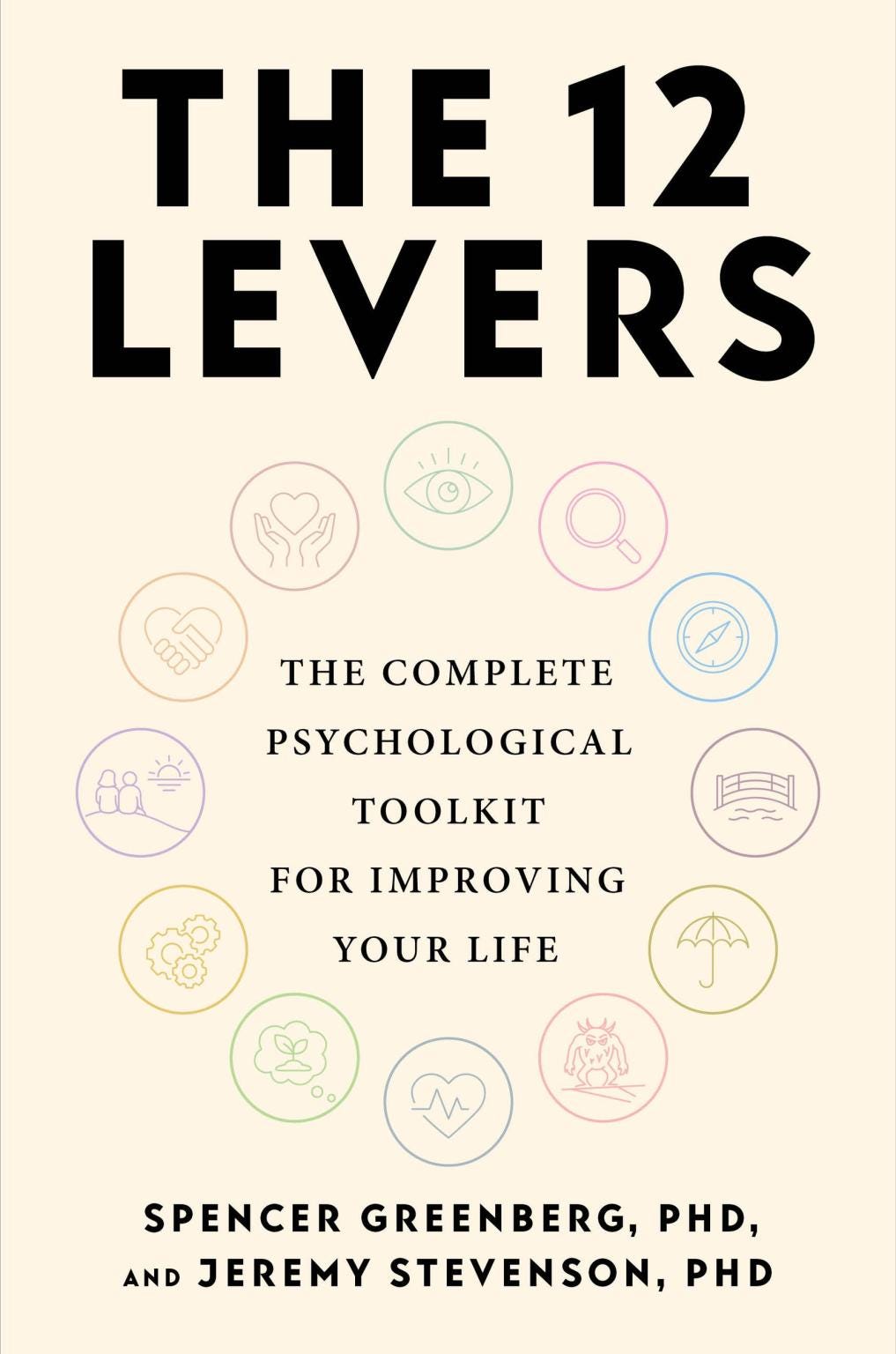
Ariel (03:45): Instead of lever one, I want to jump right into lever two, which is “uncover your guiding foundations.” I know you connect this in the book to your life philosophy, which you call valuism. Could you describe that briefly?
Spencer (04:01): Yeah. My life philosophy, valuism, is not saying how you should live your life. It’s just saying, here’s one way to live your life to consider that I find useful. So it’s just putting it out there as a consideration.
And it has two parts. It’s very simple. It says: one, try to figure out what you intrinsically value. And by intrinsically value, I mean your most fundamental, deepest values — the things you actually care about deep down, the things you would care about even if they got you nothing else. And then, two, try to take effective actions to create what you intrinsically value.
So that’s it. Figure out what you intrinsically value, take effective actions to create what you intrinsically value in the world. That’s the whole philosophy. It’s based on what is most deeply meaningful to you, but it can give some guidance, because once you figure out what you intrinsically value, then you say, okay, now I know what I’m aiming for. I’m trying to create that in the world.
Ariel (04:57): Do people all have such a clear separation between their intrinsic values and their other values? Maybe for a lot of people it’s just blurred — they kind of go with whatever people around them are doing, and they don’t necessarily have such fixed intrinsic values.
Spencer (05:13): That’s a good question, because the way the human brain thinks about values doesn’t cleanly separate intrinsic values from non-intrinsic values, which you may call instrumental values.
Let’s give an example. A lot of people pursue money — getting cash — and that’s valuable to them. There are lots of things they can do with it. But for nobody, or at least almost nobody, is cash an intrinsic value. The reason is that if you couldn’t get anything else from it — if you couldn’t get pleasure from it, social status from it, if it couldn’t give you freedom, et cetera — if you literally strip away all the things it can get you, then it’s worthless. It’s just paper. And if you couldn’t even burn it in an emergency for warmth, it’s completely useless. So once you strip all that away, it’s useless. Therefore it’s not an intrinsic value. It’s a value, but not an intrinsic value.
And because our brains don’t clearly distinguish between values and intrinsic values, that’s part of why valuism is saying something that’s less obvious than it seems. Because it’s not just saying “pursue the things that you think you want.” It’s saying, no, actually figure out the deepest things you want, the most fundamental things you want that lie beneath all the other things you want — and those are the things to go after.
Ariel (06:22): Even if those exist, should they necessarily be taken as is? What if a person’s intrinsic values seem more selfish? Maybe they should do more to try to change their values. Or let’s say a person is worried they’re in a crowd that might affect their values — maybe they shouldn’t care, because why does it matter if their values change?
Spencer (06:42): In our research on people’s intrinsic values, we ended up getting about 3,000 submissions of what people intrinsically value. We analyzed it and we deduplicated it. We also looked at what philosophers say about what people intrinsically value, and psychologists and political scientists, et cetera.
And one of the striking conclusions that we came to is that it seems nobody, or almost nobody, has truly harmful intrinsic values. Intrinsic values seem to be pretty much always either neutral or beneficial.
What I mean by that is, take a value like justice. I think most people would say, okay, that’s a good thing. Or take an intrinsic value like longevity — people would say, well, that’s certainly not a bad thing. Or take even an intrinsic value like pleasure, or having other people hold you in esteem. Those are not inherently bad. There’s nothing wrong with feeling pleasure — if anything, it’s a good thing. There’s nothing wrong with people holding you in esteem.
When people get into trouble doing bad things in pursuit of their values, it’s not because the intrinsic value is bad. It’s because the way they pursue their intrinsic value is bad. So because of that, I’ve come to think that we don’t really have good reasons to change our intrinsic values.
But that’s actually just one reason. The other reason is: on what grounds would you change them? Now, if you were convinced that there might be some objective moral truth outside of yourself — coming from utilitarianism, or coming from God — that could give you grounds to try to change your intrinsic values. But if you don’t believe in some big objective moral truth outside of yourself like that, then I would say, on what grounds would you try to change them? Those are the things you most fundamentally care about. And if there’s no objective truth outside of yourself, how would you decide which values to get rid of? Why would you get rid of the thing that you care about?
Ariel (08:30): That makes sense. I guess it’s still a question — sometimes when you look at something very closely, it dissolves a little. At the ultimate extreme, the Buddhists say the self itself could sort of be deconstructed. So I’m wondering, if people look very closely at their intrinsic values, does that weaken them a little? Or if they really dug into why they have those values, would that make them feel them a little less, because they see how they arose just from people around them or things like that?
Spencer (08:55): In my experience, no. Imagine a thought experiment of a robot that’s been programmed to only care about fetching you cheese. Now suppose you got that robot, which was intelligent, to introspect on what it cares about, and it discovers: wow, the reason I care about fetching cheese is because I’ve been programmed to fetch cheese. Does that make the robot’s value go away?
I would say no. Now it knows why it cares about it, but it doesn’t care about it any less. It’s just like, well, that’s the reason that’s the only thing I care about.
And I think it’s the same with us. Wherever our intrinsic values come from — and we could talk about that if you want — simply knowing what they are, or knowing where they came from, or knowing how they got there causally, I don’t think changes the intrinsic value itself. In my experience, introspecting on intrinsic values does not make them go away. It just clarifies them. You’re brushing away all the silt around them until you see more clearly what the intrinsic value underneath your values is. Your values often do change when you reflect, because you realize that things you thought were intrinsic were not, or that things you were pursuing were not intrinsic values.
Ariel (10:05): This view is kind of accepting of everyone’s values, and you mentioned that people basically don’t have bad values. But are there cases where it still seems reasonable to try to influence other people’s values?
I can think of an example. I was on a meditation retreat, and someone asked whether they should become a vegetarian. And the person answered: if you are bothered by it — bothered by the issues with animals — then you should consider becoming a vegetarian, but if you’re not bothered, you shouldn’t. But if someone feels strongly about it and they feel there are pretty serious ethical issues with how animals are treated, then it seems like they should want other people to also care about it, and they shouldn’t just say, you do your values no matter what.
Spencer (10:43): Of course. I’m not saying that you shouldn’t try to change the behavior of other people who have different values.
For example, let’s say you had values that were all focused on justice, and I had values that were all focused on longevity — just to make a silly example. Those could come in conflict with each other. Trying to increase longevity could come into conflict with trying to increase justice. Maybe you’re trying to create new ways of extending life, but those are not going to be distributed equally, so it’s actually going to increase injustice in some sense, or at least increase inequality in some sense.
That doesn’t mean that in that case the people shouldn’t oppose each other and try to work toward getting the thing that they think is important. Of course they should. So I’m not advocating a sort of complete live-and-let-live philosophy saying whatever people pursue is fine. What I’m saying is that this is a life philosophy about what you could consider pursuing.
Ariel (11:46): Could you give an example of some of your own intrinsic values — maybe the ones that are more unique?
Spencer (11:53): Sure. Most people, we’ve discovered in our research, have quite a lot of intrinsic values, but they tend to have a smaller number of very strong ones. So they have many, many that are weak. Almost everyone has some intrinsic value around their own pleasure, for example. But people vary — some people have it more strongly, some more weakly.
In terms of myself, I tend to have strong intrinsic values around reducing suffering, for myself and my loved ones, but also for people in the world broadly — and in fact conscious beings broadly. I also have intrinsic values around happiness, which I don’t think is quite the same as reducing suffering: increasing happiness in the world, increasing the happiness of my loved ones, increasing my happiness. And I have intrinsic values around truth — believing true things and spreading truth — and also around having a positive impact on the world through my actions.
Ariel (12:43): When you have a conflict between different values — a pure utilitarian could have a clear system where they try to calculate the utility no matter what — how do you resolve conflicts between different values?
Spencer (12:55): Well, because intrinsic values are a psychological fact about yourself, you resolve them by trying to understand yourself better. There’s not an external answer to the question of which intrinsic values you should pursue.
For example, imagine you go to a play that your friend wrote, and afterwards your friend comes up to you and says, “So what did you think?” And you know that they’re going to be extremely hurt if you give your honest opinion, which is that you thought it was terrible and had no redeeming qualities. You know they’re going to be really hurt. And you also know that it’s not going to help them in the future, because they’re not really going to take it into account and be better off because of it. So it’s just going to hurt their feelings. What do you do?
Some people’s intrinsic values will say, okay, I value being truthful more than I value not hurting my friend, so I’m going to be truthful. Other people’s intrinsic values will say, I value not hurting my friend more than I value being truthful. And that is going to depend on the person.
So when you’re trying to resolve this conflict, it’s about reflecting deeply on yourself and saying, which do I value more? Which of my intrinsic values is stronger here? And sometimes thought experiments can be helpful. For example, you could ask yourself: what would make it an easy answer? If I was hurting them only a very tiny bit and they were going to get over it in five seconds, would that be an easy answer — I would just tell them the truth? Or would that still be a hard one to answer? Thought experiments can help you figure out in more detail how you trade off your intrinsic values against each other.
Ariel (14:21): Is this introspection kind of seeing how they’ll feel after they do the action? Is that what they’re getting at? Or what are they trying to figure out when balancing these values?
Spencer (14:30): What you intrinsically value is not the same as affect — how happy you feel about something, or how much you like something. For example, you might really like puppies, but you don’t have an intrinsic value around puppies. You don’t want to maximize puppies in the world or something like that. You just like puppies, or you feel good when you see puppies. So liking something and feeling good when you see it is different from intrinsically valuing it.
Intrinsically valuing something, I think of as a very basic operation of the mind: you can imagine a scenario and you can assign value to it. Is it good? Is it bad? Is it somewhere in between? It’s not binary, it’s continuous. And I think this is something our brains do automatically — we do it without thinking about it. That’s the part of the mind I’m talking about.
Ariel (15:18): You’ve had a podcast for a while, and I know you also have a chapter in the book about conversation advice. Do you have any tips when talking to people, on how to ask interesting questions — both in a podcast and in real life?
Spencer (15:30): Yeah, maybe I’ll start with ordinary life. In ordinary life, I think good questions come about by breaking the social script — but in a way that’s not jarring or unpleasant for the other person, or at least not too jarring.
The social script that we learn to follow has certain rules to it. Someone says something, you say something that’s very related to that thing, and you follow a certain rhythm. You can have really good conversations within the social script, but I think it’s more challenging, because the social script demands a lot in terms of keeping things smooth, keeping things easy. A lot of times the way to make conversation much more interesting is to notice opportunities where the more interesting way to go is to not quite follow the social script — to go slightly off script.
That’s where the realness lies in a conversation, or where more emotionality lies, rather than doing the smooth, easy thing.
For example, let’s say someone is telling you about their job, and when they mention a certain part of their job, their face lights up. Instead of asking the automatic question you might ask, you could say, “Hey, I noticed you seem really happy when you mentioned that thing. Does that make you feel happy? And why is that?” — if that’s true. So it’s a little bit off the social script. It’s not super awkward, but it’s a little off script, and it lets you cut to something that might be more deeply meaningful to that person.
I also find that to be really important in podcasting. I think podcasts are extremely boring if they follow the social script. It doesn’t mean they’re automatically interesting if they don’t, but I think that’s one thing you have to learn as a podcaster: how to not follow the social script, to try to make the most interesting conversation for your listeners.
Ariel (17:15): Turning to how your book is organized. I know you went through a lot of self-help books and therapy techniques, but I feel like there are a lot of ways to organize it. There are even parts of the book where ideas are relevant in multiple places — certain ideas of Stoicism, for example, are relevant in a few different places. You could have had a unit on Stoicism, but it’s broken up in a few different ways. There are CBT-relevant parts earlier on, and then there’s a section on being okay with things, and then another one on Stoicism specifically. So how did you figure out how to organize it?
Spencer (17:51): Our book, The 12 Levers, began when my co-author Jeremy Stevenson and I had this question: what are all the psychological strategies you can use to improve your life?
So we started a big research project trying to answer that question. We looked at over a hundred different self-improvement books. We looked at more than 20 different types of therapy. And every time they gave a method or technique, or told you to do anything, we extracted it. We made a giant database of almost 500 different techniques.
And then we asked, for each of them: what is the underlying psychological strategy, at a high level, that this technique is about? As we went through it and tried to categorize them all, that’s where we came up with the 12 levers — the 12 psychological strategies that we found throughout all those resources. We were really surprised that we could get it down to 12. The 12 are very high-level, so they’re big groupings, but that’s where the organizing structure came from: what is the underlying psychological strategy at work in this technique?
Then we had to think a lot about how to actually organize the book. Because okay, we’ve got 12 levers, but they could come in any order. So we thought carefully about whether there’s a natural progression to them. Are there certain levers you’d want to pursue before other levers?
For example, the first lever of the book is about unraveling the deep causes of your challenges. I think that’s the right place to start, because as you learn to understand the causes of your challenges, that actually helps you through the rest of the book with what techniques to apply. If you don’t understand your challenges very well, you might use the wrong techniques. So we thought very carefully about what order they should go in, and about making adjacent chapters have relevance to each other, in addition to having a natural flow.
Ariel (19:31): So in the example I gave with Stoicism, there are different principles from it, but they fit into a certain progression — and that’s why it was broken up that way.
Spencer (19:40): Well, cognitive behavioral therapy, for example, doesn’t fit into one lever. It has many different aspects to it that come across different levers. So we’re not chunking it by “okay, where does cognitive behavioral therapy fit?” — because that’s too big a thing. We’re thinking much more granularly.
Of course, at some point in the book we have to introduce cognitive behavioral therapy for the first time, but that’s not because cognitive behavioral therapy is in that lever. It’s because we want to introduce a technique from cognitive behavioral therapy, and that’s the right time to bring it up. Same goes for Stoicism. Stoicism most closely fits into choosing your attitude, but again, it’s a broad set of things.
Ariel (20:16): Was there something you found and included in the book that you think is very useful, but is really not widely known at all — it’s not famous and people don’t know about it?
Spencer (20:28): One technique that’s really not well known, and that’s really useful for people who worry a lot — like myself, I tend to be a worrier — is a technique called worry time.
The basic idea is that people who worry a lot tend to believe that worry is useful, that it’s solving a problem for them. They also tend to believe that they have no choice but to worry — that it’s going to happen no matter what they do, and they can’t stop it. Worry time really challenges these beliefs, and can be really useful.
The basic concept is: you don’t have to do it indefinitely, but let’s say you decide to do it for three days, or for one week. You say, okay, today, every time I worry, if I haven’t had that worry yet today, I’m going to write it down — just quickly jot it down on a notepad. If I’ve already had that worry today, I don’t need to jot it down. And then I’m just going to go back to whatever I was doing, knowing that later, at a specific time — let’s say 5:30 that day — I’m going to take out that notepad of all the worries and worry about them then.
So you’re not avoiding the worry, you’re simply deferring it. You’re saying, anytime I worry, I’m going to delay it. I’m going to write it down, I’m going to delay that worry until later in the day, at that specific point in time — your worry time — and I’m going to do all my worrying then. And if I get bored during that time, after I’ve worried, I can also switch to something like problem solving, where I can pick some of the worries and work on developing a strategy to solve them.
The fascinating thing when people do this is that they tend to find they have more ability to defer their worry than they realized. They also tend to realize, in an experiential way, that the worry isn’t that useful. Because when they batch it all and say, okay, it’s 5:30, I’m going to do all my worrying now, and they sit down to do their worrying, they tend to see: yeah, this is not really doing that much for me — when I’m actually doing it consciously, in a metacognitively aware way. And actually the problem solving is just way more effective. So it can be a really useful and powerful intervention for worriers.
Ariel (22:22): It’s interesting how that works, because they probably know that the worrying isn’t helpful — the brain wants to do it anyway, for whatever reason. How does it convince the brain when you say, “I’ll do it later”? How does that work, that the brain just gives in and says, okay, I’m not going to worry now, all day, until that time? It’s kind of surprising.
Spencer (22:37): Well, a lot of worriers actually believe that worrying is really useful. It’s a very common belief among worriers. And it’s not completely wrong — sometimes worry is useful. If you’re lying in bed about to go to sleep and you hear a really loud thump outside your room and you start worrying about it, yeah, that’s probably useful. But if you continue worrying about it for two hours, that’s not useful. You should either be deciding that it’s safe and going back to bed, or you should go check on it, or call the police, or whatever. If you’re still worrying two hours later, then it’s not useful. So it’s not that worry is completely useless — it’s that people who worry typically way overestimate the value of worry.
But you’re right to point out that even if you think “no, worry is not useful,” that doesn’t make your worry suddenly stop. The idea of the technique is that as you do this, you’ll actually start to notice: hey, I had a worry, I’m going to write it down in my notebook. Maybe it comes back two minutes later. That’s fine. You just remind yourself, I already worried about that, I can let that go. And then it comes back two minutes later and you’re really tempted to worry about it, and you’re like, no, wait, I know I’m not going to worry until 5:30. I’ll deal with it then. And then it comes back again two minutes later.
So the worry time technique actually has multiple benefits. Another benefit is that it can make you more aware of how often you worry, and it can help you practice a really useful skill where you step outside the worry, put it off to the side, and say, I’m not doing that right now. So you actually train yourself through the technique to gain more distance from your worries.
Ariel (23:57): Does it work for other negative emotions more generally, like rumination or things like that?
Spencer (24:04): Rumination and worry are closely related. Sometimes those words are used to mean that things about the future are worry, and things about the past are rumination. But there can be overlap. Also, worry tends to be more associated with anxiety, whereas rumination tends to be more associated with depression — although there’s overlap there too.
But yes, it could work with rumination. It could work with any kind of thinking where you get stuck on a thought. You could practice worry time; it doesn’t have to be pure worry.
Ariel (24:35): You mentioned how many books you went through and how many techniques you went through. What was something you left out of the book that you think maybe was important but just didn’t make the cut?
Spencer (24:44): Something we left out that I wish we had put in: I wish we’d had a little bit more on identifying harmful people in your life and what to do about those kinds of situations. I do think that’s really important, and it’s been important for me, but somehow it didn’t make it into the book.
Ariel (25:02): That’s interesting, because that’s more of an external circumstance, and most of the book I feel is very focused on internals. So I wonder if that affected it.
Spencer (25:09): It is, yeah. And you could make that argument — maybe it doesn’t belong in the book. It’s sort of on that cusp of, well, you could say it is a psychological strategy, for identifying when someone’s having harmful effects on you, but then it’s also kind of more about your environment. So it’s borderline. But I do think it’s very important.
Ariel (25:27): What about more on rationalist techniques? I know you have a little on problem solving — but going into more detail about problem solving?
Spencer (25:37): The book is not so focused on rationalist techniques, except where they heavily overlap with psychological strategies for self-improvement. There’s a little bit — the pre-mortem technique, I think we talk about that in the book, where the idea is that if you have a project or goal, before it starts you imagine that it’s already failed, and then ask yourself: why did it fail? What’s the most likely reason it failed? That can be really useful for preventing a problem before it happens.
Problem-solving techniques we don’t go into too heavily in the book as a specific technique of “here is problem solving,” but I would say a whole bunch of the book indirectly deals with problem solving. A lot of it is how do you solve problems — but we’re trying to give you really specific techniques rather than super general techniques. So rather than teaching one mega-hammer for hitting problems, it’s here are lots of little hammers that are designed to solve very specific types of problems. Because we want to give you the right tool for the job, rather than just a very big, broad tool.
Ariel (26:42): One other thing — I don’t think I saw anything about flow in the book. I might have missed it, because I think that was one of the books you researched, so I’m wondering how come it didn’t make the cut.
Spencer (26:54): Yeah, it’s a good question. For those who don’t know, flow is basically the idea that during certain kinds of activities you can get so wrapped up in them that time kind of disappears, and it tends to be a very positive state. You’re really engaged, you’re focused, you’re “in flow,” as they say. The kinds of activities that tend to produce it are ones that are somewhat challenging — but not so challenging that you’re struggling, and not so easy that you’re going to get bored. You typically have a goal in these kinds of activities, and you’re usually not getting distracted during them.
I think that flow, as a self-improvement technique — I don’t know. It could in theory work as a self-improvement technique, if you’re like, okay, let’s try to design your environment for optimal flow, or something like that. But to me it’s a little bit harder to execute as a self-improvement technique per se. Although I could see the argument that we could have tried to slot it in. I think of it as more of a life design thing: people who have lives where they tend to get into flow a lot tend to be happier.
Ariel (28:03): I actually had an episode on flow, and I read the book Flow for it, and there it’s like, this is the key to all happiness. I think it maybe is just one aspect. I’m sure there are people who are happy who never really get into states of flow. So I think it varies a bit.
Spencer (28:16): Well, it’s kind of ironic, because they say that you lose track of time when it’s happening. It’s kind of funny, because I think there are ways to experience a great deal of happiness that are almost the opposite, where you’re super focused on the flow of time.
Let’s say you’re drinking a cup of your favorite coffee and you’re just super locked in on the way it tastes, the way it smells — feeling gratitude for the fact that you can have this coffee, savoring the taste of it, thinking about the meaning of the coffee. You’re really, really focused on what’s happening and not losing your sense of time at all.
So yeah, I definitely don’t think it’s the route to all happiness by any means. I think that’s a huge exaggeration. I think it is something that tends to happen in happy people’s lives.
Ariel (29:03): I know your book was very rigorous, and you tried to evaluate what has enough evidence and leave out things there isn’t evidence for. Psychology had the replication crisis — maybe it’s improved somewhat — but how were you able to evaluate, looking at studies, what really seems to be high quality and which things were more questionable?
Spencer (29:24): Psychology had a huge replication crisis, where I would say maybe 40% of papers in top journals from about 20 years ago wouldn’t replicate. So if you went and redid the experiment from scratch, you wouldn’t necessarily get the same result.
One very nice way around that is to look at work where other teams have replicated it. And if you look, many of the techniques we teach in our book — not all, but many — have been replicated by multiple teams. Independent groups have replicated them. So for example, a lot of the work around cognitive behavioral therapy, or ACT, or exposure — you’ve got tons of studies from many different groups that show the effects. That’s one way around it.
In general, though, you can also look at the quality of the work. There are certain signs, I should say, that definitely make work less reliable, so that’s one thing you can learn — to discern what sorts of studies tend to be more reliable and which tend to be less reliable.
Ariel (30:20): And then I guess there’s a question: maybe certain things fit well with randomized controlled trials, and certain things don’t fit as well. Maybe there’s important life advice — even from ancient wisdom traditions and things like that — but you can’t really study it in the same manner. Maybe it takes longer than a typical study, or maybe it’s only for certain people, so it won’t show up as well. Is there any way to still include that within your book, or a way to evaluate it?
Spencer (30:45): Yeah, we do include some things like that in our book. It would be wonderful if there were really high-quality randomized controlled trials by multiple teams on every single method that exists. But that’s just not the case. There’s lots of stuff that hasn’t been well studied but might be promising.
So we brought three lenses to this. We brought the lens of randomized controlled trials — what’s really been demonstrated — and other high-quality studies. But that has gaps, lots and lots of gaps.
We also brought the lens of my co-author Jeremy Stevenson, who is a clinical psychologist who treats patients every day. That gives him a lot of understanding of what works in practice, in a different way — not in the sense of a randomized controlled trial, but he’s doing things with his patients and seeing how they react, seeing what takes hold. So that supplements it.
And then the third lens is my own work, Clearer Thinking, where I’ve run over a hundred studies on psychology. I’ve built, I think it’s about 90 tools at this point, teaching people psychological concepts and other concepts. So I have a lot of on-the-ground work of: what do people seem to find valuable? What do people seem to be able to learn effectively, et cetera? So we brought that experience to bear, with a lot of personal data. It’s not as high quality as randomized controlled trials, but it fills in the gaps — because there are lots and lots of gaps, and you have to do something in those gaps.
Ariel (32:04): Maybe turning to Clearer Thinking a little bit — how do you evaluate there how useful the tools are, or how useful people think they are?
Spencer (32:13): In the ideal world we would run randomized controlled trials on them, but usually that’s really expensive and time consuming, and we don’t have grants most of the time. Every once in a while we get lucky and we get a grant.
Right now we had a grant for our habit tool, and we were able to run a big habit study, which was really cool. We were able to show that our habit tool, called Daily Ritual, actually helps people stick with their habits better than the control, over weeks, when they use the tool. That’s really great when we can do that. But that’s rare, and it takes so much effort.
So what we try to do is get data that’s fast and cheap but still helps guide us. Generally, for most of our tools before we launch them, we’ll run one study with the general US population and have people give immediate feedback: what was helpful, what was not helpful? Do you think this tool would be useful if many people were to use it? Why or why not? Just get any kind of feedback we can, so we can rapidly iterate.
And then, once we’ve taken that into account, we’ll generally run a second study on our own audience. We get people from our ClearerThinking.org audience who sign up as beta testers to try the tool and give us lots of feedback that way. That’s really useful as well, and we learn a lot. Obviously, again, it doesn’t replace a randomized controlled trial, but we do learn a lot about how to make our tools better, and it gives us a really tight feedback loop.
Ariel (33:38): So it lets you know if people think the tool is good, but it’s a much harder question — and you can’t evaluate it as often — what effect it actually has on their lives.
Spencer (33:46): Exactly. And it catches a lot of problems so we can fix them before the tool gets released. But it doesn’t answer the fundamental question of: does it have this impact on your life in one month? That’s a much harder question. Every once in a while we can run a study and try to actually answer that, when we get a grant.
Ariel (34:07): You have so many different resources for people to improve. What advice do you have for people to take them and actually improve, and not just consume them?
Spencer (34:17): For The 12 Levers book, at the end of every chapter we have key action steps, so that it’s very easy to find those actions. And we also have a table at the back of the book that helps point you to which lever might be most useful to you based on what you’re going through.
So what I recommend is: go to the table at the back, think about which of those apply to you, go to that lever, and go to the key actions at the end. That would be my very concrete answer to how you find what might be most useful for you. And at our website, 12 Levers Book, we’re also launching a tool that you can try that can help point you to different techniques that might be most relevant to you.
But there’s a huge question of, well, people often don’t take action. There’s the whole issue of behavior change in general — it’s been discovered that behavior change is hard, people often don’t do things, and they can get overwhelmed trying to do too much at once. So maybe that’s the bigger challenge you’re trying to point out?
Ariel (35:19): Yeah. I feel like a lot of people might read self-help books, but people don’t change as often as they read these books. So that’s a much bigger challenge, I guess.
Spencer (35:29): Yeah. Fundamentally, if you’re going to change your life, you’ve got to take action. So for example, if you want to create a new habit, you can go check out Daily Ritual. It literally walks you through creating a new habit, and it uses techniques that we’ve found, in our randomized controlled trial, actually help you stick with it.
We’ve also done a lot of research on why people often don’t engage in new behaviors even when they want to, even when the behavior is good for them. We’ve studied this in depth and we created a framework for it, which is called the Ten Conditions for Change.
Our realization in studying this is that part of why behavior change is so hard is because a lot of things have to go right for a behavior to change. We point to ten different things — if all these conditions are met, the behavior will happen. So a lot of things have to go right. And in addition, they’ll be different for different people. For one person, the seventh thing might not happen, and that’s why they didn’t do the behavior. For another person, the third thing might not happen, and that’s why they didn’t do the behavior.
So the way we think about it — and you can find this, we have a free website called Ten Conditions for Change where you can explore this — is that for a given person and a given behavior, you want to look at which of these are not met. It becomes a diagnostic tool.
To give an example: some people simply forget to do the behavior. If that’s the underlying cause, well, okay, that has a simple solution. You could add a reminder to your phone, reminders on your calendar — boom, problem solved. But for other people, it’s not that they don’t remember to do it. Maybe they remember, but they lack self-efficacy: they think, even if I do this, I’m not going to succeed. In that case, you need a totally different solution. Simply adding reminders is going to do nothing.
So my broad answer is: you’ve got to diagnose why the behavior is likely to fail. What are the conditions most likely to not be met? And then you’ve got to use targeted interventions to address exactly the ones that, for that behavior, are unlikely to be met.
Ariel (37:18): So you have this book, and you have the website Clearer Thinking, and I think you recently also launched some kind of service where people could get coaching. Assuming someone doesn’t have a serious condition, when do you think it’s right for them to just try to do self-help, read a book? And when is a life coach helpful, and when is a therapist helpful? Again, no serious condition — they’re just trying to improve in various ways.
Spencer (37:42): First of all, I will say: if you have a very serious mental health condition, I would definitely recommend seeing a therapist or a psychiatrist. I’ve seen therapists multiple times in my life. I think it can be really useful — it was useful for me. I talk about this in the book actually, about how much one therapist helped me. I don’t think there’s any shame in doing that, and many people need it.
Often, when you have a more mild to moderate challenge, self-improvement could be a good starting point. You could try it. If you don’t make progress, then you can escalate — you could try a coach. If that doesn’t make progress, you could escalate and try a therapist. So you can think about it as tiers.
There are also different kinds of problems. If you have hallucinations, don’t see a coach. That’s not going to be the right approach. If you have manic episodes, a coach is not going to help you, and self-improvement is probably not the thing you need. There’s some self-improvement that could help in that case — like maybe making a preparation plan for the next time you have a manic episode, that could be helpful. But in general you’re probably going to need to escalate and see someone who’s an expert.
So yeah, I would think about it in terms of the severity of the problem, and also staging it, where you can try the easiest thing first — which is usually self-improvement — and you can go up the stages if that’s not working for that challenge.
Ariel (38:57): I know in the book you cover a lot of different therapy techniques. I don’t know if you cover the older-fashioned ones, like psychodynamic therapy. Do you think there are cases where, instead of using the regular techniques like CBT and ACT, people should consider this kind of older-fashioned therapy to deal with deeper issues?
Spencer (39:19): There are so many different therapies, it gets a little complicated. Almost nobody really practices the therapy Freud did anymore, but there are people who are inspired by Freud’s therapy. There are psychodynamic therapies that take some ideas from Freud. There’s a whole slew of these different ideas.
It’s not as relevant to our book, because we’re focused on self-improvement, and those are more focused on things that therapists can do with you. For example, the idea of transference — which is, I think, true to some degree. The way I would describe it is that it’s the concept that you can play out roles in your life today that reflect situations in your life in the past. Maybe you had a father who never paid enough attention to you and you were always desperate to get your father’s attention, and then that can get triggered now with your romantic partner, where sometimes you’re almost replaying that situation and acting like you did back then, trying to get their attention. Or this comes up in therapy — you might be reacting in a way that’s reflective of that past role, with the therapist. And then the therapist can try to take advantage of that to help you, using the fact that it’s coming up in therapy as a way to help you explore what you’re doing and why you’re doing it, and the underlying psychological motivations going on.
So that’s an idea, but I don’t know how you do it in self-help. Maybe there’s some way to do that.
I think the biggest problem I have with psychodynamic therapies is that I think, for the most part, they’re not well proven to actually help specific problems. There are some exceptions — there is a type of psychodynamic therapy that’s been adapted to work on specific problems. And it’s interesting, because when they adapt it to work on specific problems, it starts looking a bit more like other therapies. It starts resembling the classic psychodynamic a little bit less and other therapies a bit more.
So there are some adaptations of it. But if you think about really classic, neo-Freudian-style therapy, it’s like, okay, well, where’s the proof it actually helps you with specific problems in your life? If you enjoy going to it and you find it insightful, great. But if someone’s really depressed, that’s not where I’m going to send them as the first option.
Ariel (41:31): Besides psychodynamic-style techniques, are there other things you kind of need a therapist or a specialist for, that you can’t really rely on a self-help book for — again, besides the very serious conditions?
Spencer (41:46): There are certainly a lot of things where therapists can be useful. For example, if you suffer from really intense anxiety, exposure can be a really useful method. You can self-administer exposure, but it can be more challenging. When you’re exposing yourself to things you fear in a controlled way, people can freak out and run away from the fear, and that can reinforce the fear — or they can do the exposure improperly. We talk about this in our book: what are the proper techniques for exposing yourself to things you fear so that it actually helps reduce the fear? But a therapist can guide you through that and make it a lot easier.
So I think there are many, many things where a therapist can be helpful. If you have the money or good insurance, and you have no problem going to a therapist, and you can find someone good, then yeah, fantastic. They can help you with many things, and they can even just set accountability for applying self-improvement techniques.
But there are many situations where just working on yourself is not ideal. Like if you’re in a really abusive relationship, I think having a therapist can be really valuable — because you might be in a situation where someone’s actively trying to manipulate you, or separate you from people who can help you see things clearly. Having a therapist who can guide you through that really difficult situation, or help you see reality as it is if you’re being gaslit, I think can be really, really valuable.
Ariel (43:01): There’s this famous issue with therapy called the Dodo Bird verdict. I think it goes back like 90 years — I think there was a New York Times article about it the other day. Basically it says that every kind of validated therapy — not just random methods, but ones that are sort of proven — is equally effective. Does that raise any questions? If a person’s approaching a lot of different techniques, does it just not matter, and any technique they pick will work? Or is there something that’s more relevant to a specific person or a specific issue they’re having?
Spencer (43:34): I think there’s a lot of nuance to that result, and I’ll say my views on it are a little bit different from other people’s views, so I’ll flag that I have a kind of unusual viewpoint on that particular result.
Basically, as you mentioned, they tend to test validated therapies against each other and find no difference in effect. Well, what does that really mean? First of all, it’s generally not including really wacky things or less proven techniques. Usually they’re already selecting pretty well-proven stuff and pitting it against each other.
So already, I think some people want to read the Dodo Bird effect as: it doesn’t matter at all what you do, it’s completely irrelevant, you could try to cast out spirits, it just doesn’t matter, it all does the same thing. Which I don’t think is true. We have to say, no, we’re talking about things that have already been pretty established to work. We’re not seeing big effects in the differences.
The second thing to observe is that if you’re trying to demonstrate that something beats the control group — you’re trying to say, okay, doing this therapy is better than a sugar pill — that is a lot easier to demonstrate than to demonstrate that therapy one beats therapy two, which also works, just not as well. The reason is that the difference between them is going to be much smaller, typically, than the difference between a good therapy and the control. A good therapy against another good therapy that’s not quite as good — that’s a much smaller difference than good therapy versus control. And when you’re trying to detect those small effects, you actually tend to need really large sample sizes — studies with really large numbers of people. Often the studies don’t have enough people. So it’s sort of bound to not be able to find a difference in effects, because you would need a really large sample. And if it doesn’t already have a huge sample, of course you’re not going to find it — the best you can do is say that they’re equal. So that’s another thing that I think complicates those results.
I would also say that for specific problems in life, we do have quite a bit of evidence that some things work better than other things. The evidence suggests that among proven stuff, exposure tends to work really, really well for anxiety, and I would say it tends to work better than a lot of other stuff — like more cognitive techniques for anxiety, I would argue. So I don’t think it’s like we know nothing about what works for any situation. I think in some specific situations we do have evidence that some specific things tend to work better.
The final thing I’ll say is that people vary just so much individually. So it’s actually kind of nice that there are all these things that seem to work, because there is no silver bullet. One thing that tends to work well on average may well not work for a given person. And so it’s great that we have other options — they can go to the second thing and the third thing and the fourth thing. They’re all evidence-based, and they might work for them when the first thing fails. So that’s my opinion.
Ariel (46:12): You mentioned before that you’re working on a tool to help people, connected to the book. Do you want to talk a little bit more about that tool?
Spencer (46:18): Sure. It’s an AI bot, but it’s not a therapy bot and it’s not a coach bot. It’s really just about helping people figure out what techniques from our book, The 12 Levers, can help them in their given situation. You can describe a situation you’re dealing with, and it helps you think through what the right technique to apply is, and it helps you actually walk through the technique — it helps you use that technique. That’s the basic concept.
So it’s much more scoped down compared to this idea of, let’s use AI to solve all of people’s psychological problems. But I think it could be a useful adjunct to the book, to help people put it into action.
Ariel (46:54): Is the idea that it will just tell them “you should use technique 12.1,” or will it actually give them more detail, using the power of AI?
Spencer (47:01): It will walk them through applying it step by step. So it helps them use it.
Ariel (47:05): Interesting. And what do you think about AI bots that are trying to do more than that — AI therapy bots, or AI life coaches, or things like that?
Spencer (47:16): At the end of the day, what matters here is: how much does it help people, how much risk does it have, how much harm does it cause? What is the cost-benefit ultimately, and how does it compare to the alternatives of what people would have done?
And I think at this point it’s honestly a pretty mixed bag. In some cases it can be extremely valuable — people can get really helpful insights from talking to AIs. On the other hand, sometimes it can be really harmful.
For example, as we know, these bots tend to be sycophantic, which means they tend to support what they think you want them to say. This is because the way they’re trained is, in part, that they want users to give a high rating saying “that is an answer I like.” That’s part of the training. And because people like being told that they’re right, they literally get trained to tell you you’re right.
Now, in therapy this is a really big problem. Good therapists do not go around telling their patients they’re right about everything. In fact, sometimes good therapists say — or at least lead the patient to come to understand — that they’re wrong, that their perceptions are wrong. A core idea in cognitive behavioral therapy, for example, is that often our thoughts are misleading and we can learn to challenge our thoughts.
So I think that’s a really big problem when trying to use these systems for therapy: their orientation toward the user is not the correct one for a therapist by default. It doesn’t mean someone can’t improve that, or make a much better one, but I think the out-of-the-box configuration is not ideal.
Ariel (48:45): I think even the general bots have improved since ChatGPT-4o, and they’re not as bad in terms of that.
Spencer (48:49): Yeah, they’ve toned it down. They’re still, honestly, still sycophantic, but it’s not nearly as bad as it was.
Ariel (48:56): And some of it, I feel like even with a system prompt you could tune it a little.
Spencer (48:59): Absolutely.
Ariel (49:00): I’m sure people are working on more sophisticated bots. They would do more than just a system prompt, and then they could address some of these issues, at least to some extent.
Spencer (49:10): Yeah, and I do expect they’ll be able to do better than the default out-of-the-box Claude or ChatGPT, because they can proactively address some of the issues. But some of the issues might also be baked into the earlier training, so it might be hard to remove.
Another actual challenge of using these AIs is that they tend to be very overconfident, and I think that can be a problem as well in these situations — where the bot can state something really confidently that might be wrong or misleading or just an unhelpful idea, and then people can actually overindex on it. So that’d be another thing I’d be wary about. I think a good therapist is going to try not to give really overconfident opinions that might lead people astray.
Ariel (49:51): And you have all these tools on Clearer Thinking. I know you mentioned the one just now, to guide people to which lever to use from your book. But have you thought of doing more — using AI to enhance some of these tools?
Spencer (50:04): Yeah, we’ve experimented with it a bit. In our module on how to have productive disagreements, we let you do a practice round with an AI where you can practice the techniques for having better disagreements that lead to more productive results. So that’s an example.
And we’ve been experimenting in other ways. The way I think about it is: how do you use AI to do work that is ideally higher quality than what you’re doing now? Because I think the easy thing to do with AI is to do lots more work that’s lower quality. I think that’s often the trap right now — people generate a bunch of crap. I think the more valuable use cases of AI are often doing things better than you’re doing them now. Do more, but do it better, increase quality.
That’s not always easy — it’s a challenge, right? Because AI makes mistakes and things like that. But that doesn’t mean it’s insurmountable. I’m looking for ways to do that, and I think we’ve found some interesting ways, but I’m still on the lookout for how we use AI in a way that continually increases our quality.
Ariel (51:01): The example you gave, to help people with disagreements — that seems pretty low risk. They’re not asking about major life decisions, they’re just practicing a certain skill. And AI could probably do a good job letting them practice.
Spencer (51:11): Yeah. And it’s a better kind of practice than just putting it in a text box with no response. So I think it’s a clear win.
Ariel (51:20): Why do you think that society overall, and the education system, doesn’t really emphasize these kinds of skills that much? It seems a lot of what they teach in school isn’t particularly useful, and here are things that are actually useful, and they either don’t teach it, or teach it to a very minimal extent that’s not enough to actually help people. Do you have any thoughts about why that is, or what should be done about it?
Spencer (51:43): The kind of institution that school is came about through a history that’s related to the content that’s taught today. It didn’t start as a place to teach you to be psychologically attuned to how your mind works, or to be happy. It came about as a place to teach you specific things that you should know as an adult, and that can make you fit into a workforce, and this kind of thing.
And then institutions are sticky. Once things are taught, they stick around. That becomes a field, it becomes a subject, and then there are teachers of that thing, and the teachers of that thing work at schools, and some of them become administrators, and it self-propagates.
I mean, I think writing, reading, arithmetic — as is famously said — those are all really, really useful, and clearly should be taught in schools. I think for some of the other stuff, probably learning psychological skills would be more useful.
If we really thought about it: what’s the purpose of school now? What do we want it to be? Not just what has it been historically, but what do we want it to be? What are the important skills we want children to grow up with?
There was an attempt to teach preventative psychological skills in schools, and my understanding is that the evidence didn’t look very good in the end when they tested it — it just didn’t help very much. But that doesn’t mean it couldn’t help. It’s like, okay, that particular program didn’t seem to pay off, but I do think there are psychological skills that could help you a lot.
It might be a challenge to figure out how to work them into the curriculum: what skills exactly to teach, how to teach them, and how do you make them stick? Because really the purpose is getting people using them in their everyday life. That’s actually one of the big challenges with school in general — a lot of what people learn, because they don’t have an immediate use for it in life, they just forget by the next semester, if not the next week. So I think that would be a challenge: if you’re teaching psychological skills in school, how do you get them to stick, and how do you get people using them?
Ariel (53:34): I think in a way schools used to do more. Traditionally, if you go back a hundred-whatever years, they did try to teach character more, and I feel like that faded over time. More recently they’ve been doing a little social-emotional learning, but I don’t think they do enough to really let people learn. I think a lot of it would need to be done in a more real-world scenario — in a classroom it just would be useless, and schools aren’t good at figuring out how to let people practice things in the real world. Maybe that’s an issue in general: it’s hard to teach someone a real skill when for real skills you need the real world.
Spencer (54:10): Yeah, schools are not always the best at that. You get all these funny things in math class, like, “this is Joe’s favorite triangle, figure out the length of the missing side.” And you’re like, what are we talking about here? So yeah, it doesn’t always do the best at making it practical. But I think some teachers do do a good job at that — maybe that’s just not the default.
Ariel (54:32): Besides your book, is there one or two other books you would recommend to people if they wanted to improve, and that you just think are very helpful?
Spencer (54:45): One book that I love, one of my early introductions to psychology — it’s for people with depression in particular — is Feeling Good by David Burns. I think that’s a lovely book.
I also think if you just really want to deep-dive on habits, then Atomic Habits is a great place to start. It’s a very easy read, it’s very popular, and it has a lot of good, basic information on habits. That is a good one.
Ariel (55:05): I remember David Burns was on your podcast, and I found it very interesting. There might have been certain things I disagreed with here or there, but he clearly cared so much about improving, and always asking his patients how he could improve. He had so much compassion that he showed. So I thought that was a very interesting episode.
Spencer (55:24): Yeah. And for anyone listening, if you want to check that out, just search for the Clearer Thinking podcast and David Burns. I’ve actually done two episodes with him: one on how to have better relationships, and one on going beyond cognitive behavioral therapy — what are his newer views on how to do even better and more effective help than cognitive behavioral therapy for people with psychological challenges.
He’s a fascinating person, and he actually popularized cognitive behavioral therapy for the general public. He wrote one of the first books — Feeling Good, the one I mentioned — that really made people aware of it, and I believe it sold millions of copies, if I’m not mistaken.
Ariel (55:59): We mentioned some of your resources, but what do you want listeners to remember? Where can they find you, and what should they check out afterwards?
Spencer (56:09): If you found this conversation interesting, we’d love for you to check out the Clearer Thinking podcast. We also have over 90 free tools you can use on our website, ClearerThinking.org. And we send out a weekly newsletter, usually about psychology, that a few hundred thousand people subscribe to — you might find that interesting. So yeah, I’d love it if you check that out.
Ariel (56:27): Okay, thanks so much.
Spencer (56:29): Ariel, thanks so much for having me.