

Bryan Caplan recently asked ChatGPT to do a sentiment analysis of his writing alongside Tyler Cowen’s, Robin Hanson’s, and Paul Krugman’s. As I discussed in my guest post on Bryan’s Substack, AI’s agentic modes (such as Claude Cowork and ChatGPT Work) allow for very extensive research - they can gather data, write scripts, and systematically go through sources.
While Claude merged Claude Cowork and Chat mode, ChatGPT for now still has separate chat and work modes,.
I figured I could redo the analysis with ChatGPT Work and also throw Alex Tabarrok into the mix. I asked ChatGPT to prepare a methodology in advance, and to distinguish between different emotions. Besides a simple sentiment analysis, I had the AI model itself run over a 1,000-post sample so it could dig deeper and better interpret things like sarcasm. Here’s the full report; below is ChatGPT’s write up of the analysis:
Bryan Caplan’s sentiment comparison of Cowen, Hanson, himself and Krugman offered four vivid portraits: exuberant Caplan, restrained Cowen, detached Hanson and angry Krugman. How well do those impressions hold up across a defined body of writing?
We checked 3,873 public written posts, published from January 1, 2025 through September 30, 2026, adding Alex Tabarrok. Dictionary tools (VADER and NRC) scored language across the corpus; an LLM read 1,000 sampled posts, 200 per writer, selected by quarter and format and weighted back to each available corpus.
The familiar contrasts largely held up. The additions were more revealing: format changes a positivity ranking, Tabarrok separates approval from warmth, Cowen’s alarming examples were uncommon in this window, and negative forecasting moved in opposite directions for Hanson and Krugman.
The familiar patterns held up
The frozen LLM rubric scored seven qualities separately, including joy, warmth, anger and anxiety, on a 0–3 scale: absent, mild, clear and strong. We requested GPT-6.1 Sol at medium reasoning and hid bylines and site branding from the inputs.
Caplan shows more joy and warmth than Cowen; Krugman more anger and expressed anxiety than the equal average of the other four. Those contrasts survive essay/book-review restrictions, separate years, word weighting and omitting each publication month in turn.
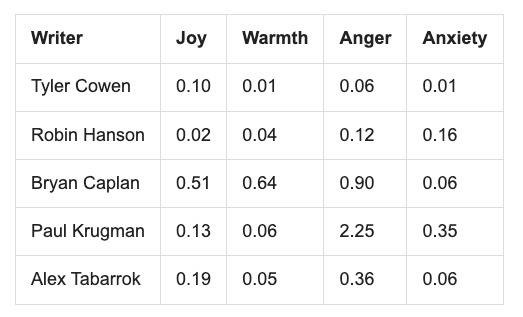
LLM rating, 0–3.
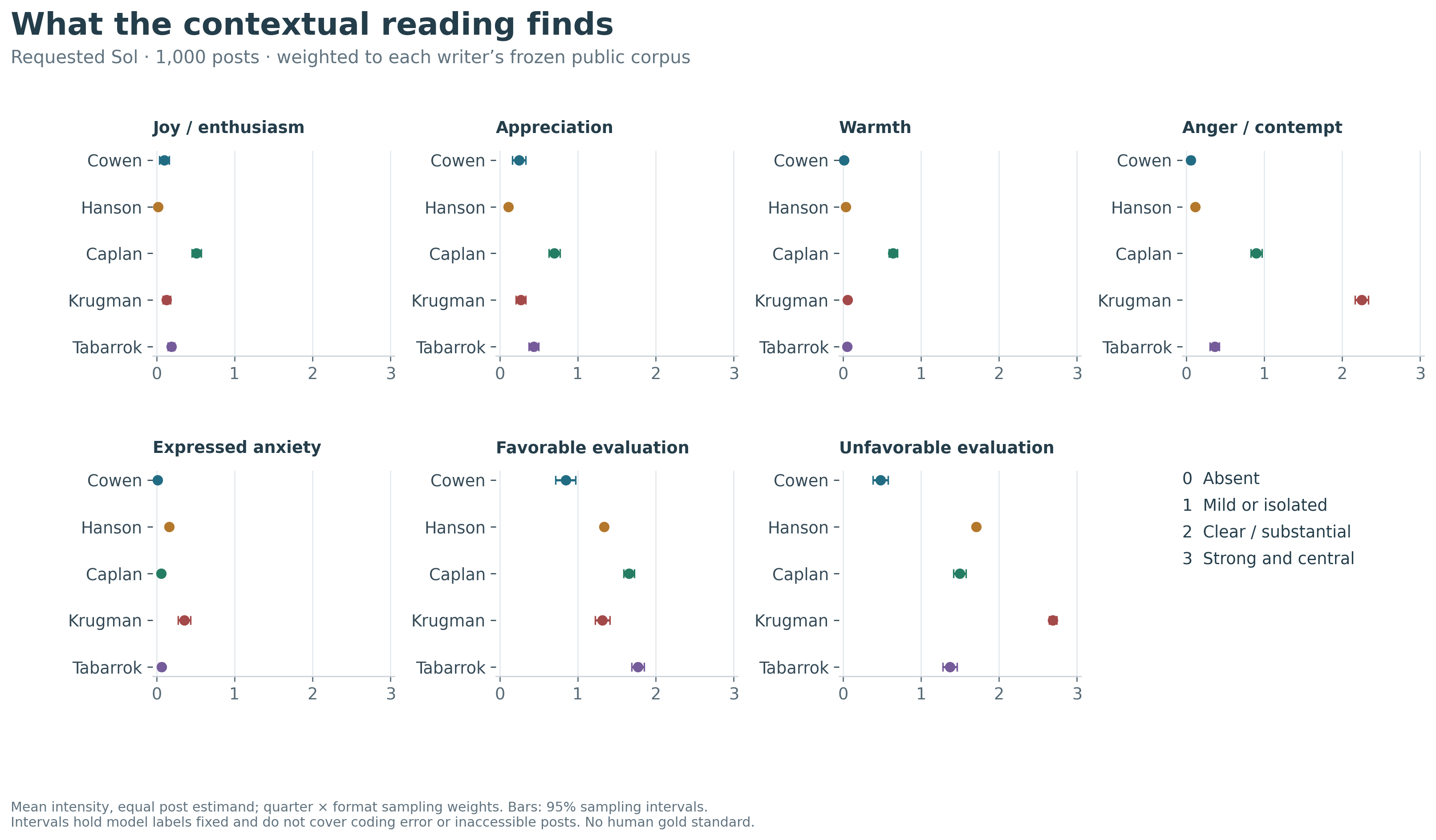
Caplan’s warmth coexists with substantial anger; Hanson’s frequent unfavorable judgments come with little angry affect. These are properties of the coded prose, rather than measurements of the writers’ private emotional lives.
The positive ranking changes with the measure
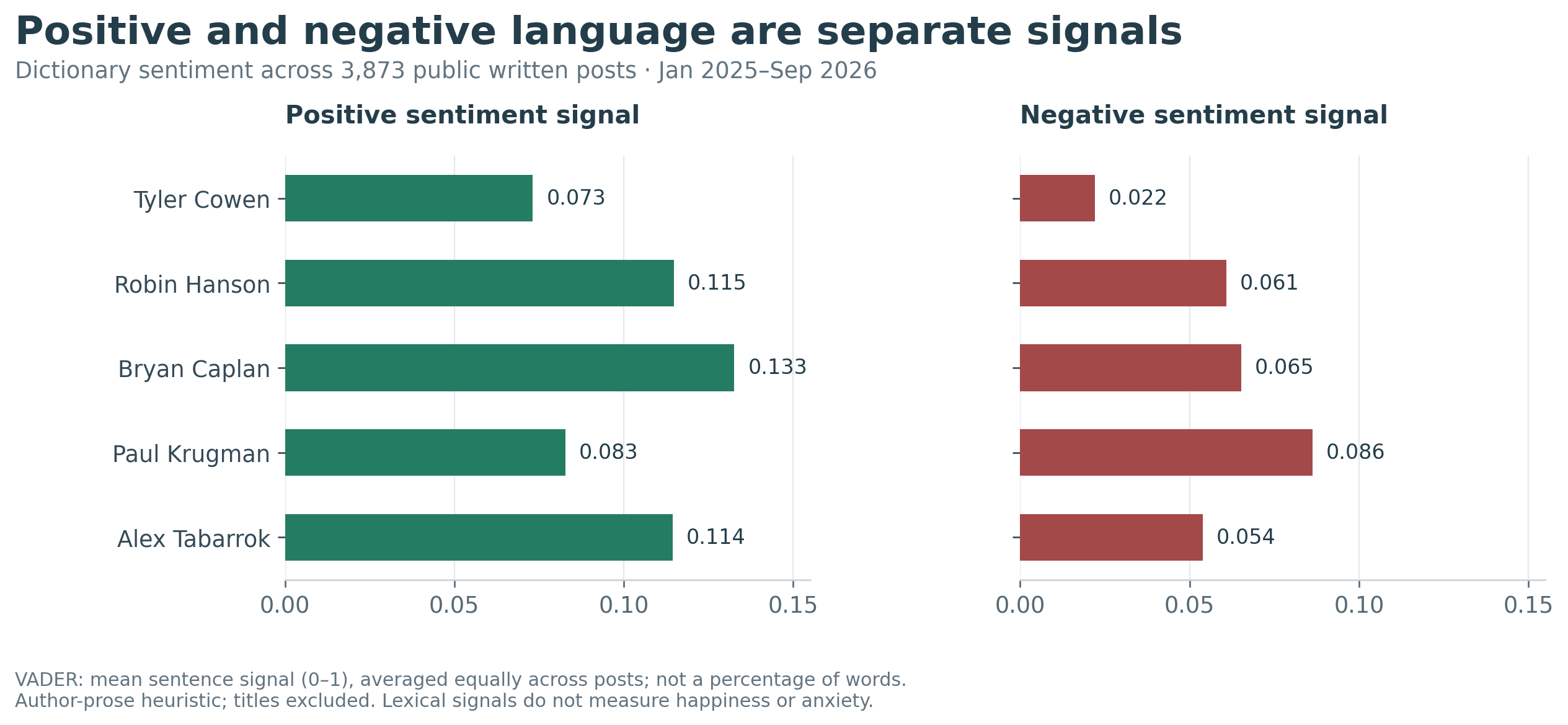
VADER gives Caplan the highest positive-language signal and Krugman the highest negative signal. But Hanson has the highest net compound score, despite frequently anticipating bad outcomes. His lexical ranking is an unexpected addition to the original comparison. The original suggested that dictionary scoring could make Hanson look excessively negative; in this window, the net lexical measure instead puts him first.
Format also changes the Cowen–Caplan ranking. Across all posts, Caplan’s net score is 0.106 versus Cowen’s 0.088. In essays and book reviews, Cowen leads 0.126 to 0.077. Caplan’s contextual joy and warmth advantages survive the same restriction. Lexical net positivity and overt enthusiasm respond differently to the choice of content. The net scores use a −1 to +1 scale.
Tabarrok separates approval from warmth
Adding Tabarrok reveals another profile. His favorable-evaluation mean is the highest point estimate, 1.77 versus Caplan’s 1.66. Yet his joy averages 0.19 versus 0.51, and warmth 0.05 versus 0.64. Positive judgments need not come with much personal exuberance or affection. His mean anger of 0.36 sits between Cowen’s 0.06 and Caplan’s 0.90. He supplies an intermediate comparison: substantial approval without Caplan’s social warmth, and criticism without Krugman’s anger.
Cowen and the frequency of alarm
One revision concerns Cowen. The original post emphasized his laconic expressions of worry. Our checked output contains qualifying risk discussion in about 10.5% of posts, versus 58% for Hanson and 82.4% for Krugman. Cowen also has the lowest mean anger. This window’s publication mix looks less alarm-heavy than his famous catchphrases might suggest.
Cowen publishes many brief posts and links, so this describes frequency in his available output. Implicit concern could be undercounted. Across writers, discussing danger also greatly exceeds expressing anxiety: Hanson’s rates are 58% versus 11%, and Krugman’s 82.4% versus 20.1%.
A further addition is where the model detected sarcasm: 39% of Krugman’s weighted posts, versus roughly 4–5% for Caplan and Tabarrok and 0.5% for Cowen. The rubric required evidence of ironic meaning, beyond insults or exaggeration; it could miss subtle deadpan delivery. These rates remain exploratory.
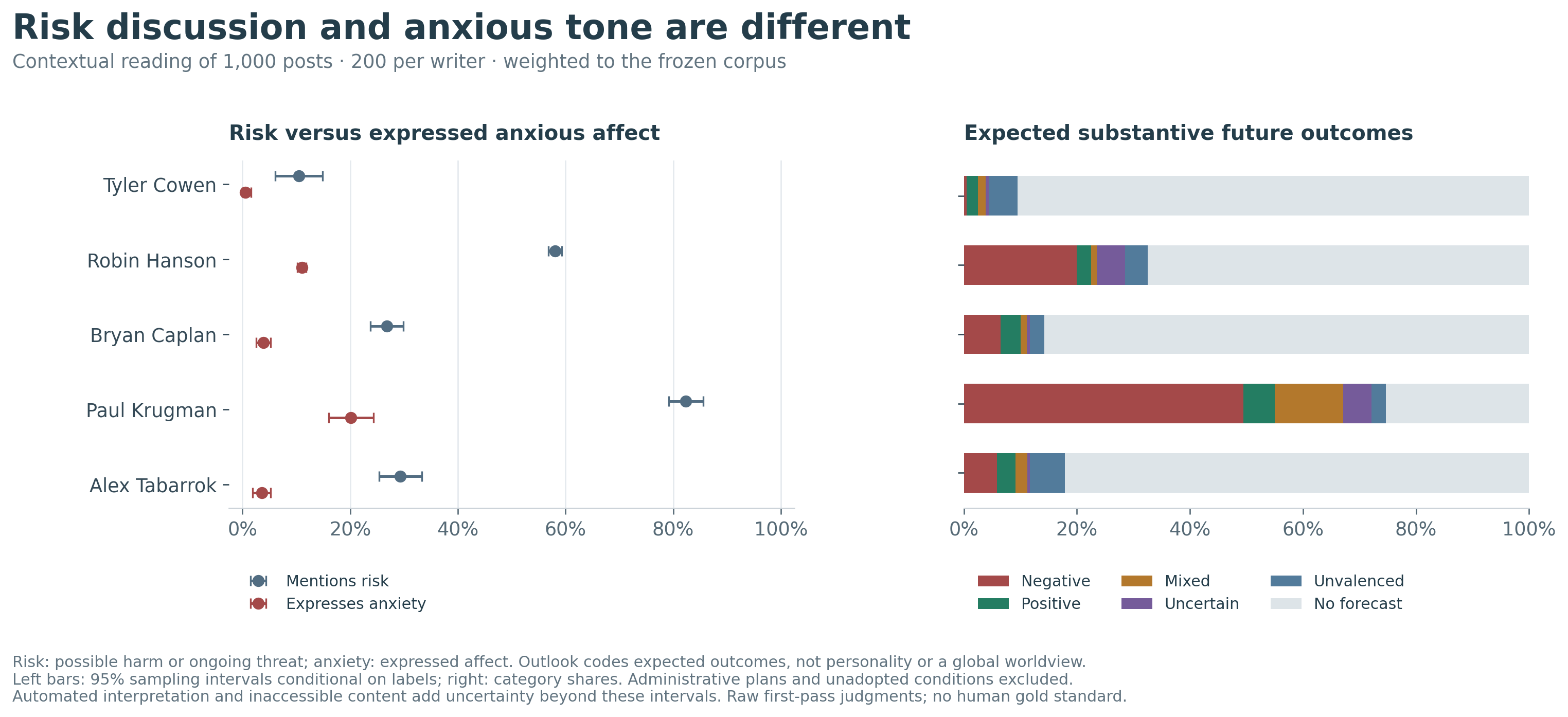
Risk, anxious affect and ordinary future outlook are separate constructs. Sampling bars hold labels fixed; forecast categories are mutually exclusive.
Negative forecasts changed in opposite directions
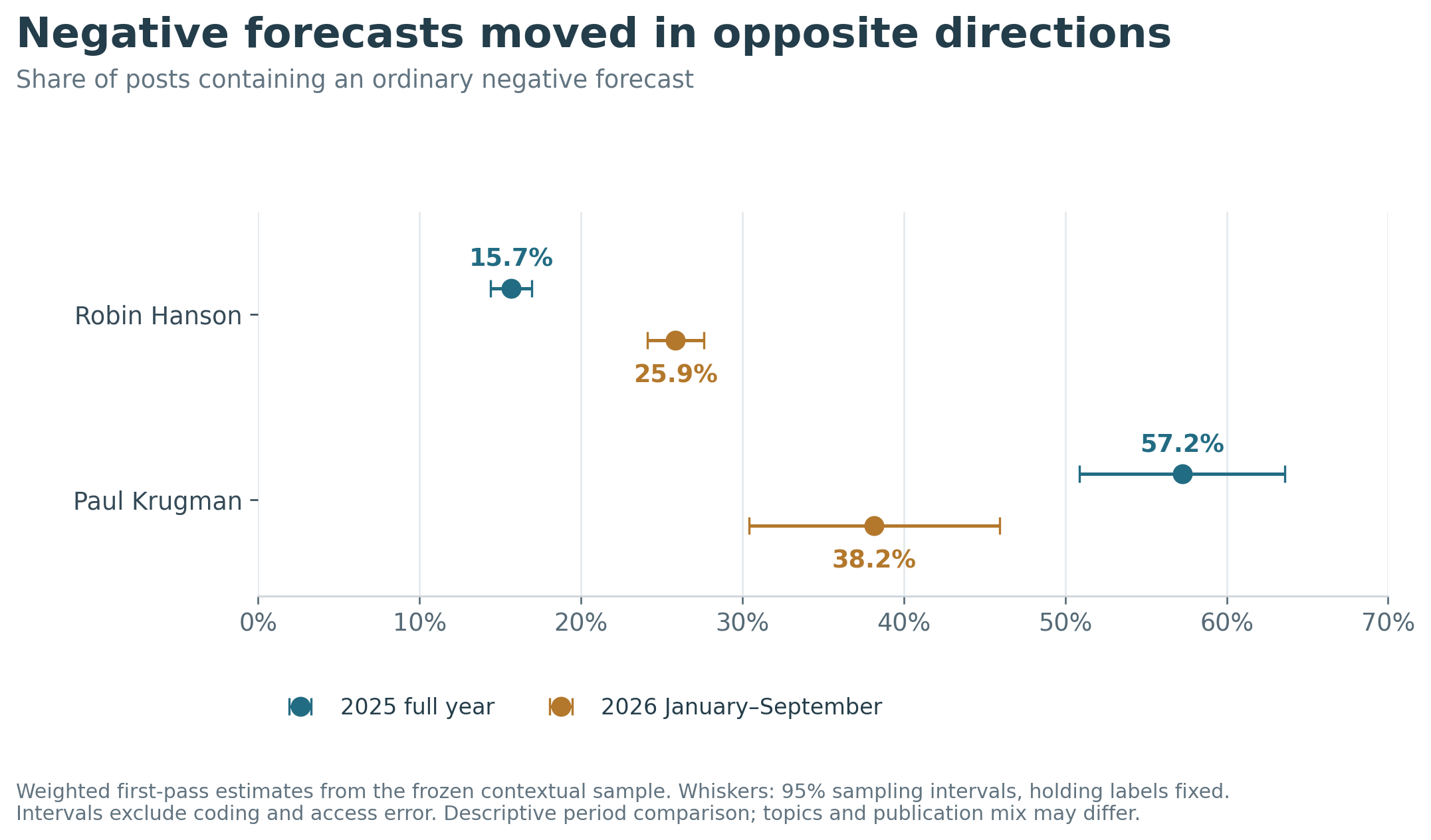
Between 2025 and January–September 2026, Hanson’s share of posts containing negative forecasts rose from 15.7% to 25.9%; Krugman’s fell from 57.2% to 38.2%. These count expected bad outcomes, rather than simply mentioning a risk. Krugman’s mean anger barely changed, 2.26 to 2.23, while his share of negative-forecast posts declined.
These are descriptive period comparisons. Topics and publication mix may have changed; they do not establish a long-term trend.
What the checks can establish
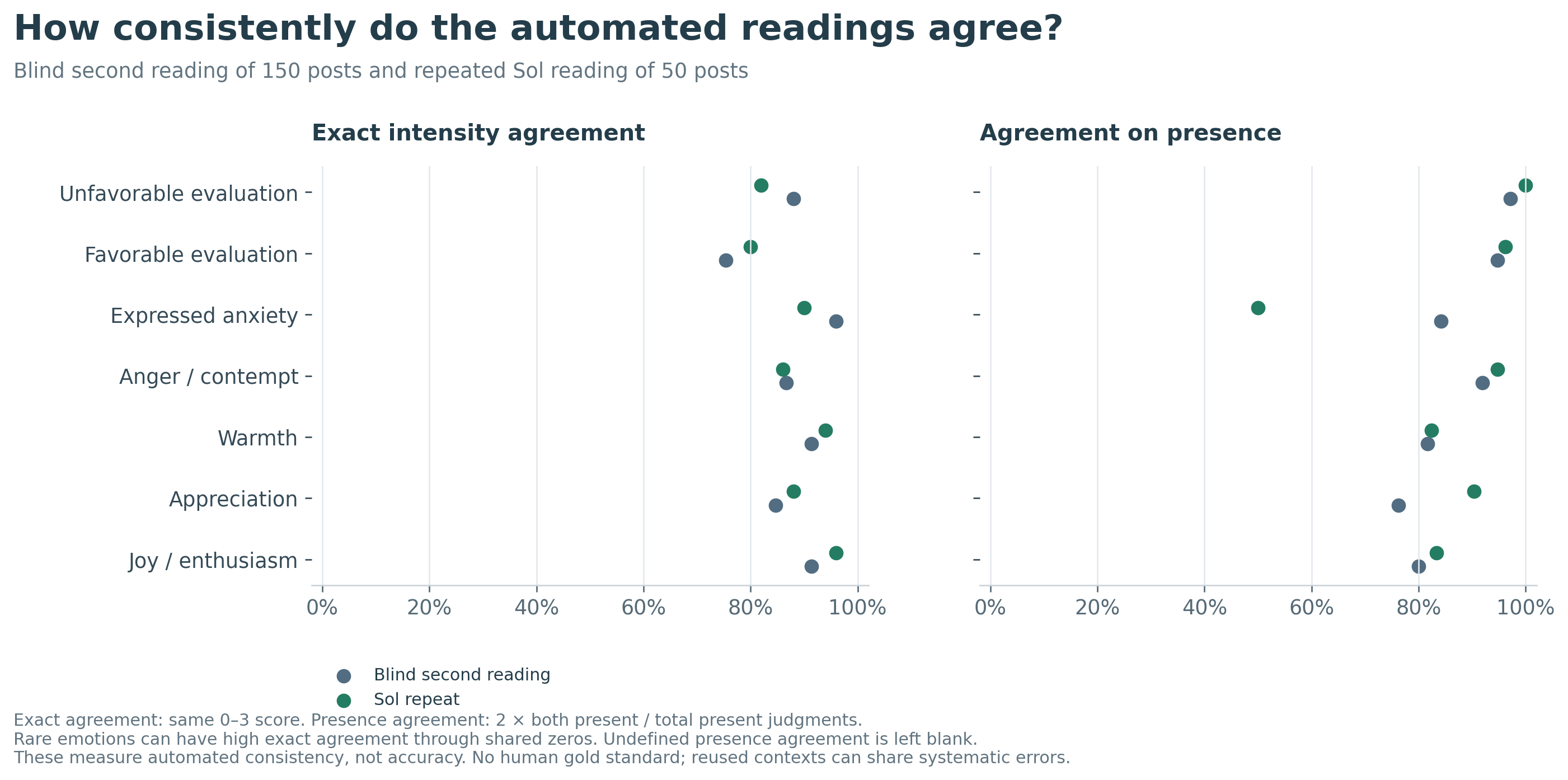
A blind automated second reading of 150 posts gave 75.3–96.0% exact agreement across intensity dimensions; nearly every disagreement was within one point. We also repeated 50 readings and reviewed 65 prespecified ambiguous or disputed cases against their sources. Applying the proposed corrections leaves the four main contrast directions intact.
Consistency does not establish accuracy. Anxiety illustrates the difficulty: repeats matched exactly 90% of the time, but agreement on its presence was only 50%. Shared zero answers inflate exact agreement. There is no human gold standard.
The limits of the comparison
Topic choices still matter. No topic × format × quarter cell had enough sampled posts for all five writers, so we cannot isolate a pure writing-style effect. The results describe the checked prose within this window. The full methods report records the content checked, rubric, weights, review results and sensitivities.