OpenAI announced today that their (unreleased) swarm of AI agents solved a Millennium Prize problem, proving a negative resolution to Navier–Stokes. (See also WSJ.)
There’s some controversy around how they did it - they focused millions of dollars of compute on the Millennium Prize problems (and eventually focused it all on Navier–Stokes) since there was a rumour that Anthropic had solved one or two of the problems. It turned out Anthropic the company wasn’t even working on it - two mathematicians were making progress on the problem and one was an employee at Anthropic pursuing the problem in his personal capacity. It must not feel great for those mathematicians - they were on the path to solving one of the most famous open problems in math but OpenAI beat them to it since it heard a vague rumour of their work.
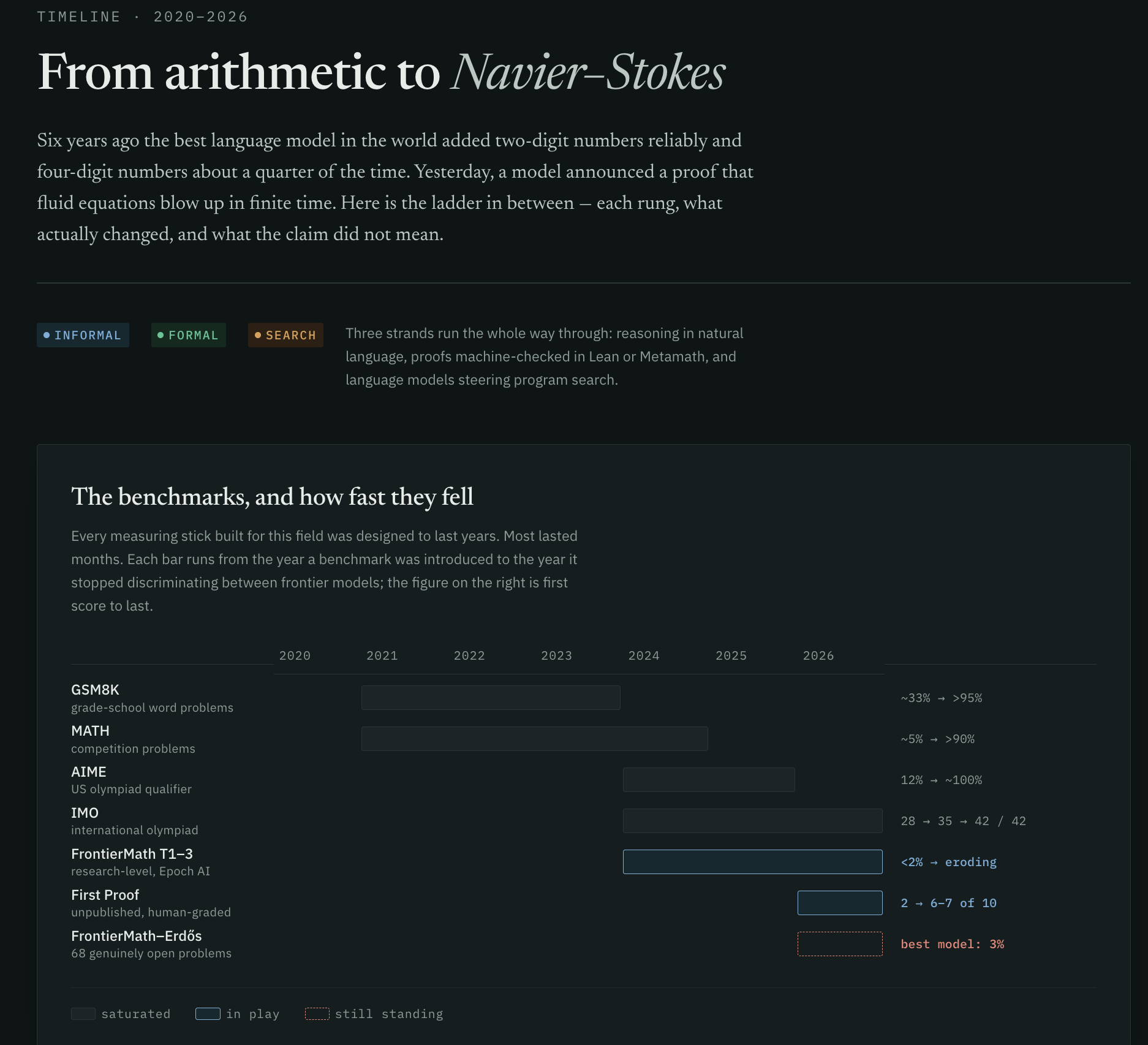
The mathematicians had also used OpenAI’s AI models during their research, so there’s a chance that their work made its way into the training of the models. This doesn’t seem likely, but OpenAI couldn’t completely rule it out, and it puts a small asterisk over their results. With that acknowledged, it’s pretty shocking how rapidly AI has progressed at math. In 6 years, it went from struggling with basic arithmetic to solving one of the most famous unsolved problems in math.
In honor of this occasion I asked Claude to create a timeline of the AI breakthroughs in math since LLMs came on the scene.